
SCALING IMPACT, UNLOCKING OPPORTUNITY

Cover of the Reclaim Fund Ltd Annual Report and Accounts 2025/2026, featuring two young people on yellow chairs in front of a green hedge, with the title SCALING IMPACT, UNLOCKING OPPORTUNITY
Reclaim Fund Ltd — Annual Report and Accounts 2025/2026 cover

OVERVIEW

THE SMART WAY TO UNLOCK THE POTENTIAL OF DORMANT ASSETS

Reclaim Fund Ltd (‘RFL’) helps financial institutions to protect their customers while creating a better society.

Unlocking the potential of dormant assets to drive positive change across the UK, we are proud to have welcomed our first Participants from the Investment and Wealth Management sector into the Dormant Assets Scheme, and adjusted our reserving model to enable more funding to flow to good causes.

CONTENTS

STRATEGIC REPORT

Opening of the Investment and Wealth Management sector Go to page 16

GOVERNANCE

Statement of Directors’ and Accounting Officer's responsibilities Go to page 56

FINANCIAL STATEMENTS

OTHER INFORMATION AND PARTICIPANTS

FROM DORMANCY TO DISTRIBUTION

Outlining the spend direction of surplus dormant funds, and their geographical impact.

Go to page 12

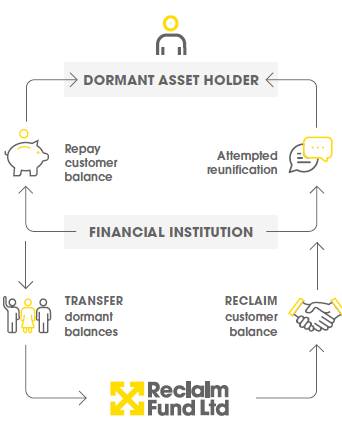
Dormant Assets flow summary — DORMANT ASSET HOLDER, FINANCIAL INSTITUTION, Reclaim Fund Ltd. Attempted reunification, RECLAIM customer balance, TRANSFER dormant balances, Repay customer balance
Dormant Assets Scheme — summary flow diagram

£82,404 TO HELP CREATIVE YOUNG PERFORMERS IN SCOTLAND

SUPPORTED BY youngstart

Go to page 14

Annual report figure — page 3
Young Start logo
Young Start — funding creative young performers in Scotland
SUPPORTED BY youngstart — £82,404 to help creative young performers in Scotland

SCHEME EXPANSION

Celebrating our four trailblazing Participants leading the way in the Investment and Wealth Management sector.

Go to page 16

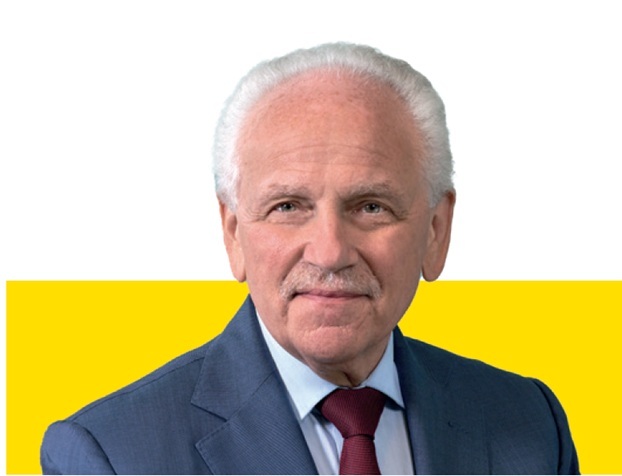
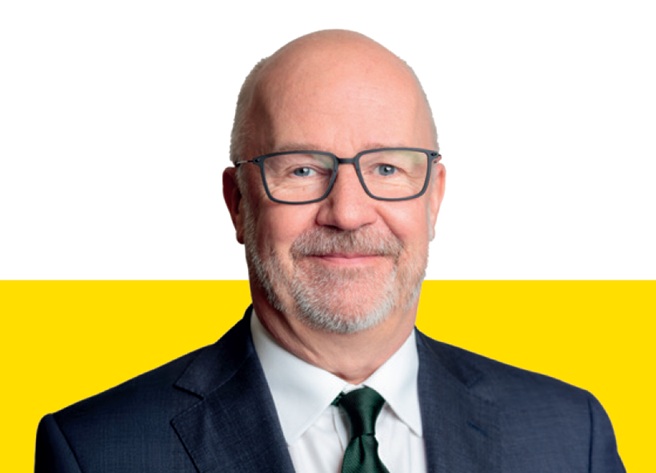
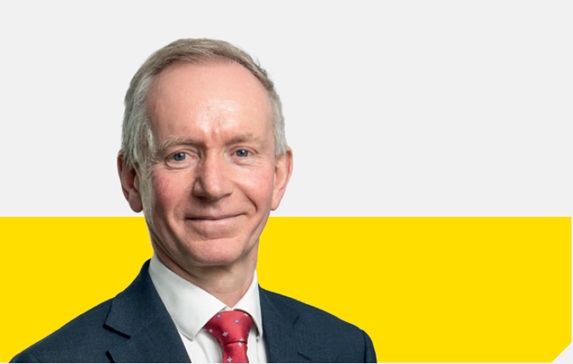
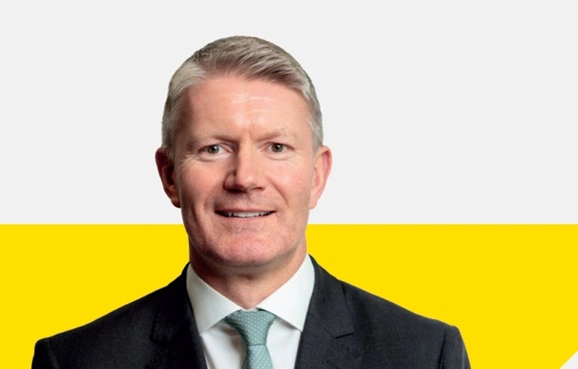
Four trailblazing Participants in the Investment and Wealth Management sector
SCHEME EXPANSION — four trailblazing Participants in the Investment and Wealth Management sector

AT A GLANCE

THE SMART WAY TO UNLOCK THE POTENTIAL OF DORMANT ASSETS

RFL is the operator of the UK's Dormant Assets Scheme ('the Scheme'). This voluntary initiative enables inactive financial assets to be utilised for social good, while fully protecting the rights of their owners.

By choosing to take part, Participants can protect their customers while unlocking the potential of dormant money, transforming unused funds into lasting support for communities across the UK.

Overseen by The National Lottery Community Fund ('TNLCF'), the funds distributed helps to improve the financial resilience of charities, social enterprises, and vulnerable communities, as well as tackling issues such as homelessness and young people's wellbeing.

On top of driving real-life, transformative impact at scale, joining the Dormant Assets Scheme also helps Participants to maintain a strong, lean, and efficient balance sheet. RFL take on full liability for the funds transferred to us, and we expertly maintain reserves to refund Participants for any customer reclaims – in perpetuity, and with any interest owed.

With our bespoke support, over 60 financial institutions – from major banks and multinational investment firms to small community-based building societies – are already choosing the smart way to unlock the potential of dormant assets.

IF YOU THINK YOU HAVE A DORMANT ASSET

If you think you have a dormant asset, please contact your original product provider. Alternatively, the following free tracing services may be able to assist.

  • Banks & Building Society accounts – MyLostAccount
  • Pension schemes – Government pension tracing service
  • Multiple assets – Gretel
  • Multiple assets – The Tracing Group

OUR PURPOSE

We unlock the potential of dormant assets to enhance communities and enrich lives.

OUR MISSION

We safeguard the rights of dormant asset holders while optimising the financial benefits for good causes.

OUR VALUES

  • COLLABORATION

    We share our skills and expertise for a better outcome

  • EVOLUTION

    We embrace and celebrate change

  • INTEGRITY

    We try to do the right thing, all of the time

  • RESPECT

    We show respect to each other and all those we come into contact with

  • RESPONSIBILITY

    We all have a personal role to play in meeting stakeholder expectations

DORMANT ASSETS SCHEME1

Dormant Assets Scheme flow diagram — DORMANT ASSET HOLDER, FINANCIAL INSTITUTION, Reclaim Fund Ltd, attempted reunification, reclaim customer balance, transfer dormant balances, repay customer balance
Dormant Assets Scheme — process overview

PRINCIPLES OF THE DORMANT ASSET SCHEME

1. REUNIFICATION FIRST

Consumer protection is the first priority of the Dormant Assets Scheme.

Participants must first make concerted, reasonable efforts to reunite the money with its rightful owner before it can be considered ‘dormant’.

2. VOLUNTARY PARTICIPATION

The Scheme is voluntary for financial institutions.

Eligible organisations can choose whether to contribute to the Scheme and to what extent.

3. RIGHT TO RECLAIM

Customers reclaim the value of assets through their provider, which is then reimbursed by RFL. RFL ensures that sufficient funds are reserved so this guarantee can always be fulfilled.

Transfer surplus funds to THE NATIONAL LOTTERY COMMUNITY FUND — England, Scotland, Wales, Northern Ireland — GOOD CAUSES
Dormant Assets Scheme — fund distribution to Good Causes

1 Excluding Alternative Scheme.

2025/26 HIGHLIGHTS

UNLOCKING POTENTIAL TO DELIVER IMPACT

RFL is proud to have opened the Dormant Assets Scheme to the Investment and Wealth Management sector, welcoming four trailblazing firms as our first sector Participants.

Working hard to maximise distributions while protecting customers, we have also adopted a sophisticated new reserving model. Building on over £1.3 billion which has already been released, this new approach, combined with the significant amount of dormant assets received this year, has resulted in the largest distribution in RFL’s history – taking us to a cumulative £1.6 billion unlocked for good causes.

This report demonstrates some of the transformative impact of this funding and how RFL is driving continued growth of the Scheme.

Key distribution figures

£1.6bn

TOTAL SET ASIDE
FOR GOOD CAUSES

£1.3bn

CUMULATIVE PAID TO
NATIONAL LOTTERY
COMMUNITY FUND

£370.3m

APPROVED FOR
DISTRIBUTION
THIS YEAR

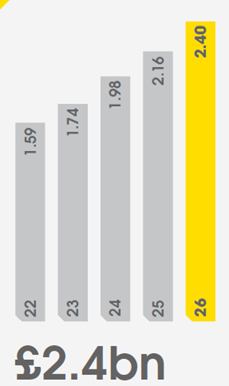
DORMANT ASSET BALANCES TRANSFERRED SINCE INCEPTION

Bar chart showing dormant asset balances transferred since inception: £1.59bn (2022), £1.74bn (2023), £1.98bn (2024), £2.16bn (2025), £2.40bn (2026) — cumulative total of £2.4 billion over 5 years
Cumulative dormant asset balances transferred since inception reached £2.4 billion in 2025/26, up from £2.16 billion the prior year

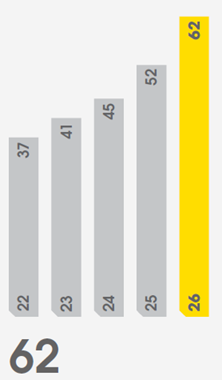
PARTICIPATING FIRMS ACROSS ALL SCHEMES

Bar chart showing growth in participating firms across all schemes: 37 (2022), 41 (2023), 45 (2024), 52 (2025), 62 (2026) — 62 firms by 2025/26
Participating firms across all schemes grew from 37 in 2021/22 to 62 in 2025/26, reflecting expansion into new sectors including Investment and Wealth Management

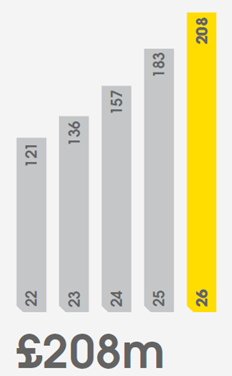
CUMULATIVELY RECLAIMED BY ACCOUNT HOLDERS

Bar chart showing cumulative amount reclaimed by account holders: £121m (2022), £136m (2023), £157m (2024), £183m (2025), £208m (2026) — reaching £208 million in 2025/26
Cumulatively reclaimed by account holders reached £208 million in 2025/26, up from £183 million the prior year

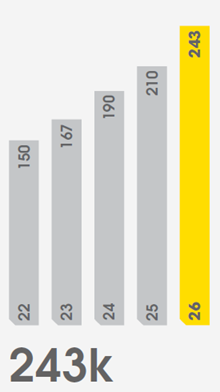
ACCOUNTS CUMULATIVELY RECLAIMED

Bar chart showing accounts cumulatively reclaimed: 150k (2022), 167k (2023), 190k (2024), 210k (2025), 243k (2026) — reaching 243,000 accounts by 2025/26
Accounts cumulatively reclaimed grew to 243,000 in 2025/26, up from 210,000 the prior year

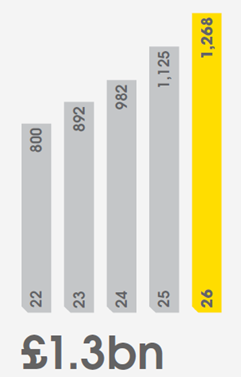
DISTRIBUTIONS PAID

Bar chart showing distributions paid: £800m (2022), £892m (2023), £982m (2024), £1,125m (2025), £1,268m (2026) — cumulative total of £1.3 billion in distributions paid
Distributions paid reached £1.3 billion cumulatively in 2025/26, up from £1,125 million the prior year

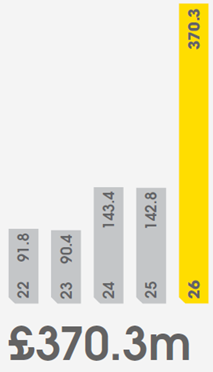
APPROVED FOR FURTHER DISTRIBUTION TO TNLFC

Bar chart showing approved distribution to TNLFC: £91.8m (2022), £90.4m (2023), £143.4m (2024), £142.8m (2025), £370.3m (2026) — surging to £370.3 million in 2025/26 driven by a revised capital and reserving strategy
Approved for further distribution to TNLFC reached £370.3 million in 2025/26, more than double the prior year, driven by a more efficient capital and reserving strategy

CHAIR’S REVIEW

MAXIMISING THE IMPACT OF THE SCHEME

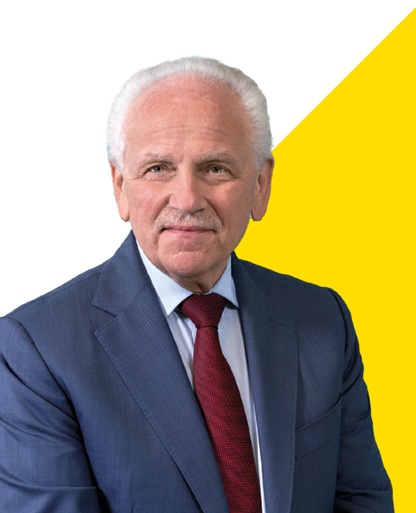
Portrait of Lawrence M. Weiss, Chair of Reclaim Fund Ltd
Lawrence M. Weiss, Chair

OUR GROWTH AGENDA

From increasing participation to maximising distributions, growth has been my top priority ever since I joined RFL as Chair in 2023. So, it is with great pride, then, that I can report that the 2025/26 financial year has been defined by meaningful growth across two of our most vital priorities: driving voluntary participation and maximising the impact our work has on society.

LANDMARK EXPANSION

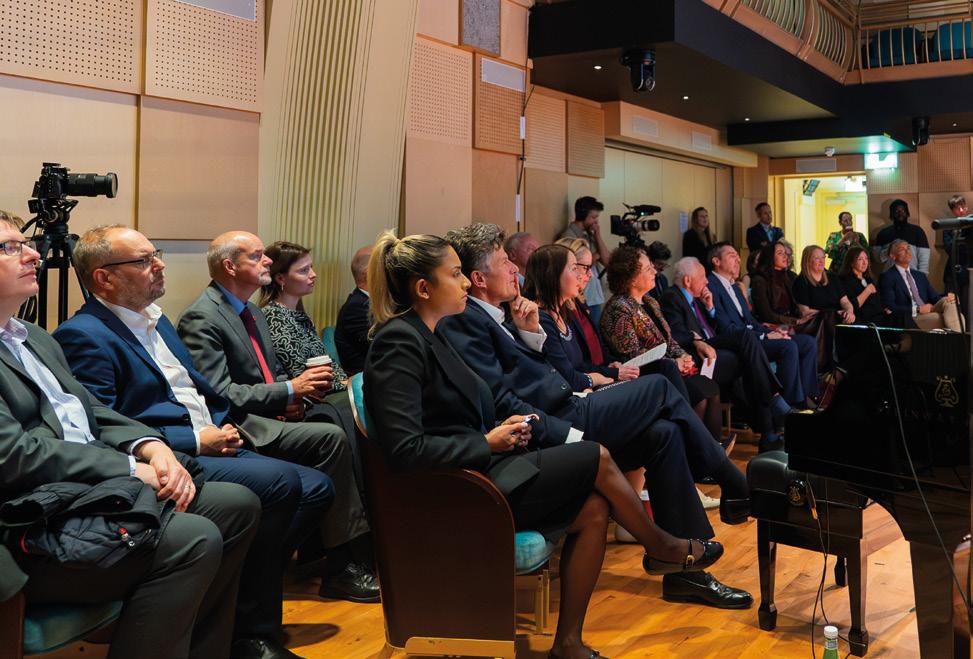
During the 2025/26 financial year, we celebrated the expansion of the Dormant Assets Scheme into the Investment and Wealth Management sector. This has been many years in the making, and I was delighted to attend a major launch event in October 2025 with our first four Participants from the sector – Jupiter, Schroders, JP Morgan, and Janus Henderson – as well as the Economic Secretary to the Treasury (‘EST’) and the Minister for Civil Society at the Department for Culture, Media and Sport (‘DCMS’).

The launch was held at World Heart Beat, a music academy in South London that has received social investment through the Scheme. World Heart Beat empowers young people through music, working to break down barriers that too often prevent the UK’s talented but disadvantaged youth from thriving in the creative arts. Hearing from several of the young musicians – and being treated to a vibrant jazz performance – was a poignant reminder of the way the Dormant Asset Scheme can transform lives and enrich British culture.

MAXIMISING OUR IMPACT

This year has also seen the adoption of a new reserving model for the Banking sector within the Scheme, resulting in our largest distribution to date. This represents a major milestone in RFL’s history as we move away from a static 60% distribution policy, and I would like to thank the RFL team, the Board and specifically its Audit and Risk Committee, and His Majesty’s Treasury (‘HMT’) for their hard work, dedication, and close scrutiny of the new model.

Our core mission remains steadfast: to safeguard the rights of dormant asset holders while optimising the financial benefits for good causes. As a Board, we remain duty-bound to ensure RFL is prudently resourced, and I am confident that the new strategy delivers that security while maximising the impact of the Scheme. RFL is the expert at navigating the unique requirements that come with being the UK’s trusted custodian of dormant assets, and we look forward to supporting our Participants to unlock even greater funding through the Scheme.

ENDURING PURPOSE

After fifteen years of operation, and now with over £1.6 billion released, REI is ensuring sustainable funding can reach good causes that would not otherwise receive public support. We remain dedicated to protecting customers’ money, modelling responsible governance as an Arm’s Length Body and FCA-regulated entity, and continuously improving how we deliver our unique mandate.

I would like to thank the entire Board for their ongoing dedication and commitment to this work. On behalf of us all, I would also like to thank Holger Vieten, who stepped down from the Board in August 2025 after three years of providing expert advice and wise counsel. We were delighted to welcome Rubaba Khan in September 2025 as his replacement and our Shareholder Representative Non Executive Director (‘NED’). We are grateful to them both for facilitating the close, constructive relationship we continue to enjoy with UKGI – as well as, of course, with HMT and DCMS.

With a new, dedicated development focus embedded in the business, I am looking forward to celebrating further growth across our expanded sectors in the coming years. We will work to ensure that the Scheme fulfils its potential to become the best practice, standard mechanism for managing dormancy – and that RFL remains the trusted partner-of-choice for firms seeking to make a responsible, UK-wide impact with these funds.

Annual report figure — page 9
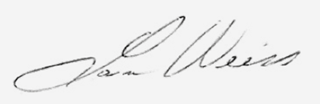
Lawrence M. Weiss signature

LAWRENCE M. WEISS

Chair

8 July 2026

RFL is the expert at navigating the unique requirements that come with being the UK’s trusted custodian of dormant assets, and we look forward to supporting our Participants to unlock even greater funding through the Scheme.

— Lawrence M. Weiss, Chair

CHIEF EXECUTIVE'S REVIEW

GROWING RESPONSIBLY TO INCREASE IMPACT

Portrait of Adrian Smith OBE, Chief Executive of Reclaim Fund Ltd
ADRIAN SMITH OBE, Chief Executive

The success of RFL is, first and foremost, a story about our people. Our dual mission fosters a distinctive and highly motivated culture that is essential to our lean operation and ability to expertly safeguard people’s money.

— Adrian Smith OBE, Chief Executive

OUR PEOPLE DRIVE OUR SUCCESS

It has been a truly exceptional year at RFL. As the Chair’s review sets out, we have made great strides against our strategic vision and are deeply proud of the successes we have seen over the last 12 months.

The success of RFL is, first and foremost, a story about our people. As a unique, not-for-profit organisation, our staff couple technical expertise with a strong sense of social purpose. Our dual mission fosters a distinctive and highly motivated culture that is essential to our lean operation and ability to expertly safeguard people’s money.

This year saw significant changes to our Executive team. We established a new function, taking on a dedicated Chief Development Officer to drive external engagement, alongside recruiting a new Chief Operating Officer with a laser-sharp focus on Account Management, Technology, and Change. Taryn Nicholls and Adam Barton both have long histories with RFL, and we are glad to benefit from their passion and expertise.

We also bade a very fond farewell to Alistair Paterson, who had served as RFL’s Chief Risk Officer since 2023 and was pivotal in creating the systems and structures to ensure RFL is managed appropriately as we grow.

DELIVERING RESPONSIBLE IMPACT

Expertly led by our Chief Financial Officer, Paul Singleton, the team has worked tirelessly this year to develop a sophisticated capital and reserving strategy that further aligns with our mission: to safeguard the rights of dormant asset holders while optimising the financial benefits for good causes. I am delighted that the outcome of this work will allow us to unlock a greater proportion of dormant accounts this year, alongside making a sizeable capital release of £370 million.

Our approach to this work has remained rooted in the Scheme’s core principle that reunification comes first. We safeguard every asset with the understanding that its rightful owner may come forward at any time. Our work ensures that this promise – protection in perpetuity – is not just a slogan, but a lived reality. This year alone, we refunded our Participants for over 33,000 customer reclaim, marking a cumulative £208 million that has been reunited through the Scheme to date.

WORKING IN PARTNERSHIP

A key highlight of the financial year was undoubtedly the launch of the Scheme into the Investment and Wealth Management sector. This was not a simple extension; it was a complex operational undertaking requiring the development of new processes, bespoke onboarding efforts, and close collaboration with our trailblazing early adopters.

I want to express my sincere gratitude to the leaders and project teams across all the different organisations involved for their determined work to make this launch happen. There is a well of untapped potential in this sector, and we look forward to working in partnership with our public and private partners to realise it.

THE PATH AHEAD

2026 marks 15 years since RFL first opened its doors to our original banking Partnerships and launched the Dormant Assets Scheme. As one of its first employees, I can say firsthand what an incredible journey it has been for the business. I look forward to celebrating this anniversary over the 2026/27 financial year and leveraging our expertise to drive even further growth in the years to come.

Signature of Adrian Smith OBE
Adrian Smith OBE signature

ADRIAN SMITH OBE Chief Executive

8 July 2026

A SHARED COMMITMENT TO POSITIVE IMPACT

Diagram showing the shared commitment to positive impact — key stakeholders and partners of the Dormant Assets Scheme
A SHARED COMMITMENT TO POSITIVE IMPACT

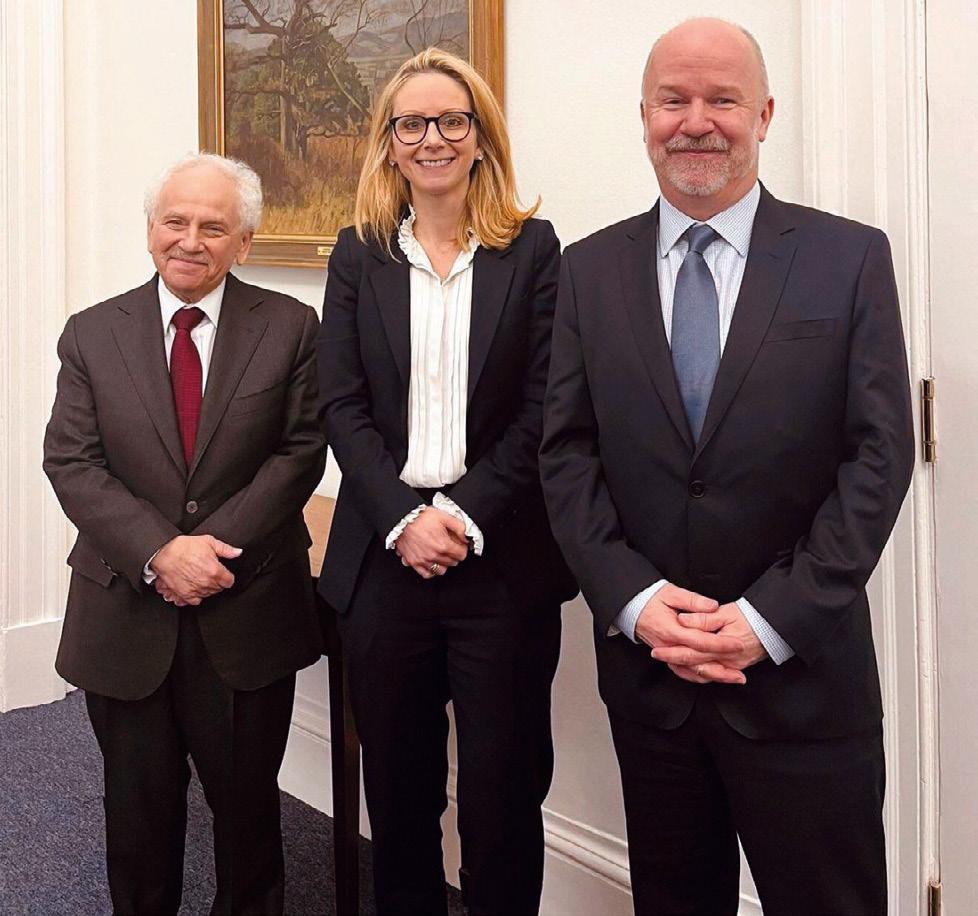
It was a privilege to meet with Lucy Rigby KC MP, then-Economic Secretary to the Treasury, alongside our Chair, Lawrence M. Weiss. Our discussion provided a valuable opportunity to reflect on the achievements of the Dormant Assets Scheme and to consider its future potential.

We have been particularly encouraged this year by Minister Rigby’s clear and informed support for the Scheme. During our meeting, we highlighted how funding derived from dormant assets is already making a significant and tangible difference in communities across the UK.

We are grateful for the Minister’s strong backing, which we believe reinforces the importance of continuing to grow and strengthen the Scheme in partnership with Government and the wider sector. We look forward to continuing this collaboration as we advance our shared ambition: to ensure that dormant assets are mobilised to deliver enduring and positive change for communities nationwide.

ACCESS - THE FOUNDATION FOR SOCIAL INVESTMENT - ENGLAND

£150,000 IN GRANT FUNDING TO HELP SUSTAINABLE EMPLOYMENT

Nuneaton Signs is a Warwickshire-based social enterprise. Providing employment and skills development for people with disabilities, they received support through the Enterprise Growth for Communities programme to expand their operations.

With investment enabled by £150,000 in dormant assets funding, the organisation opened a second site in Hinckley, upgraded their machinery, and increased production capacity by 144% - creating even more training and employment opportunities.

The Enterprise Growth for Communities programme, delivered by Access - The Foundation for Social Investment, blends grants with repayable finance to unlock affordable investment for charities and social enterprises.

Through this support, Nuneaton Signs has been able to grow both its trading income and its social mission - demonstrating how dormant assets can help to strengthen communities and expand opportunities for people who face barriers to employment.

144%

INCREASE IN PRODUCTION
CAPACITY, EXPANDING
EMPLOYMENT OPPORTUNITIES

SUPPORTED BY

ACCESS - The Foundation for Social Investment

Access — The Foundation for Social Investment logo
Access — The Foundation for Social Investment
Annual report figure — page 13
Nuneaton Signs is a Warwickshire-based social enterprise

Social investment has been transformative for us, enabling us to scale faster without compromising our mission.

— DAREN HOLLINS, Procurement Director, Nuneaton Signs

DORMANT ASSETS SCHEME

FROM DORMANCY TO DISTRIBUTION

The principal activity of RFL is the receipt and management of dormant asset monies.

ABOUT RFL AND THE DORMANT ASSETS SCHEME

RFL is a Non-Departmental Public Body, owned by HMT as its shareholder, and authorised and regulated by the Financial Conduct Authority (FCA).

The Dormant Bank and Building Society Accounts Act 2008 (‘2008 Act’) and the Dormant Assets Act 2022 (‘2022 Act’) together enable institutions in banking, insurance and pensions, Investment and Wealth Management, and securities sectors to choose to participate in the Dormant Assets Scheme. Participants can transfer to RFL money held in eligible dormant assets, such as bank and building society accounts which have seen no customer-initiated transactions for 15 years. Legislation protects the right of dormant asset owners to reclaim their money at any time by transferring the individual’s claim against the Participant to RFL. All activities are underpinned by the 2008 and 2022 Acts (‘the Acts’), RFL’s Framework Document with HM Treasury, as well as RFL’s Articles of Association. A Transfer and Agency Agreement (‘TAA’) is also in place between RFL and each Participant that establishes the contractual framework between the parties. Participation in the Scheme by eligible institutions under the Acts is voluntary.

RFL manages the money that it receives in accordance with the Acts and relevant regulatory requirements. RFL ensures that it always has enough money available to meet any customer claims that may arise, as well as to satisfy its capital requirements and meet its reasonable expenses. If the Board of RFL determines that there is surplus money available, the 2008 Act enables it to distribute the money to TNLCF for social or environmental causes across the UK.

The Acts establish two variations of the Dormant Assets Scheme;

  • a Main Scheme for eligible institutions across all sectors; and
  • an Alternative Scheme for smaller banks or building societies with balance sheet assets of less than £7 billion.

Under the Main Scheme, the entire balance of a dormant asset is transferred to RFL. Under the Alternative Scheme, a smaller bank or building society may transfer an agreed proportion of a dormant account’s value to RFL with the remainder being distributed to charities that are aligned with the relevant Participants’ social purpose in their communities. The tables on pages 90 and 91 list the organisations that participate in the Schemes and the value of dormant balances that they have transferred to the Scheme.

Before transferring any dormant asset monies to RFL, Participants must try to reunite dormant asset owners with their funds. Where this proves unsuccessful, balances that meet the criteria set out in the Acts and requirements in the TAA may be eligible for transfer to RFL.

If dormant asset owners subsequently wish to reclaim their money, the Participant is appointed under the TAA to act on behalf of RFL to reunite individuals with their funds. Participants remain responsible for managing all aspects of the customer relationship: RFL holds no customer information and customers therefore have no direct relationship with RFL.

WHERE DOES THE MONEY GO?

This year, we developed a sophisticated new reserving model, which has enabled us to unlock more funds for good causes from our Bank and Building Society Participants’ transfers. About two-thirds of dormant accounts received over FY2025/26 were distributed to TNLCF, as well as the additional capital release of £185 million. Together, this has led to the largest distribution in RFL’s 15-year history.

TNLCF is responsible for delivering dormant assets funding programmes and for distributing funds to spend organisations across the UK, in line with priorities set by each of the four nations. In England, these priorities are determined by the Secretary of State for DCMS; in the devolved nations, they are set by the relevant administration.

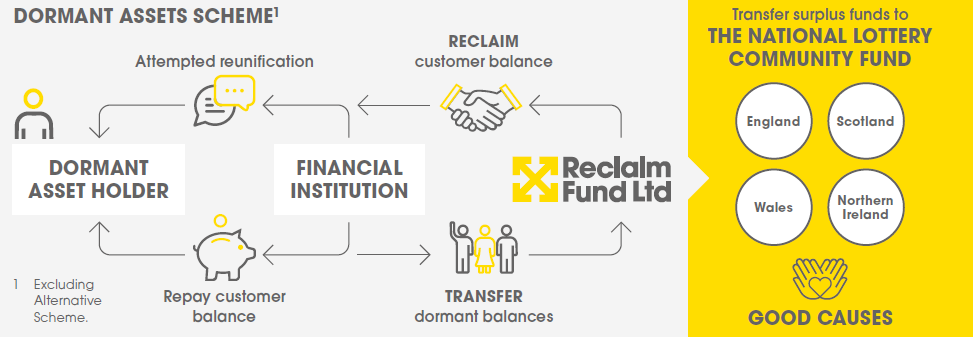
Dormant Assets Scheme infographic showing the flow of funds: Dormant Asset Holder to Financial Institution (with attempted reunification), to Reclaim Fund Ltd (via transfer of dormant balances), with surplus funds going to the National Lottery Community Fund for distribution to Good Causes across England, Scotland, Wales and Northern Ireland. Customers can reclaim their balance at any time.
Dormant Assets Scheme — full process flow from dormant asset holder to good causes

Description: The Dormant Assets Scheme operates as a cycle: the Dormant Asset Holder holds a dormant account with a Financial Institution (e.g. a bank or building society). The institution attempts to reunite the customer with their funds before transferring dormant balances to Reclaim Fund Ltd (RFL). RFL safeguards the funds and makes surplus monies available to The National Lottery Community Fund, which distributes them to Good Causes across all four UK nations: England, Scotland, Wales, and Northern Ireland. At any stage, customers retain the right to reclaim the full value of their dormant balance directly from RFL.

SPEND ORGANISATIONS IN ENGLAND

Most dormant assets funding in England has been distributed to the four independent spend organisations listed below, each delivering programmes aligned to the Scheme’s priorities.

Under the 2025 strategy, these organisations will continue to contribute their expertise, with TNLCF directly delivering some new programmes of work in line with the Government’s priorities, notably the Community Wealth Fund and youth enrichment initiatives.

CURRENT DORMANT ASSET SPEND PRIORITIES

ENGLAND

Priorities: Financial inclusion, Youth, Social investment wholesalers, Community Wealth Fund

SCOTLAND

Priority: Young People (Young Start Programme)

youngstart — Delivered by THE NATIONAL LOTTERY COMMUNITY FUND

tnlcommunityfund.org.uk/funding/funding-programmes/young-start-small-grants/

WALES

Priorities: Climate change, Environment, Sustainability, Young people

CRONFA GYMUNEDOL COMMUNITY FUNDtnlcommunityfund.org.uk/welsh/

NORTHERN IRELAND

Priority: Increasing the capacity, resilience and sustainability of the voluntary, community and social enterprise sector

Dormant Accounts Fund NI — Delivered by THE NATIONAL LOTTERY COMMUNITY FUND

tnlcommunityfund.org.uk/funding/funding-programmes/dormant-assets-for-all/

THE DORMANT ASSETS SCHEME STRATEGY

In June 2025, the Government published the Dormant Assets Scheme Strategy, setting out how £440 million of dormant asset funding will be directed in England. The Strategy aims for the Scheme to become the best practice, standard mechanism for eligible firms to manage dormancy and for participation to further expand. The Strategy acknowledges that the prospect of unlocking hundreds of millions of pounds more through the Scheme over time highlights the importance of a delivery model capable of supporting long-term, UK-wide programmes — and ensuring funding efficiently and effectively reaches communities that need it most and where it can have the biggest impact.

THE OVERSIGHT TRUST

The Oversight Trust is an independent organisation that oversees the long-standing spend organisations for dormant asset funding in England. Its role is to ensure these organisations continue to operate in line with their missions. The Oversight Trust is the sole member of Fair4All Finance, Youth Futures Foundation and Access (all companies limited by guarantee), and the majority shareholder of Better Society Capital (a company limited by shares).

Under DCMS’s new 2025 strategy, TNLFC will play a more central role in shaping and coordinating the delivery of dormant assets funding for the Community Wealth Fund and some youth enrichment initiatives, while The Oversight Trust continues to provide independent oversight of the spend organisations’ governance, mission alignment, and impact.

YOUNG START — SCOTLAND

£82,404 TO HELP CREATIVE YOUNG PERFORMERS IN SCOTLAND

Hydra Arts, a creative organisation based in West Dunbartonshire, has received £82,404 through The National Lottery Community Fund’s Young Start programme, which distributes dormant assets funding in Scotland. This investment will support an ambitious, 2.5 year international performance project designed with a group of young performers aged 13 to 25.

The project brings together young people in Scotland and Canada, who will collaborate through slow, non-digital communication methods to exchange ideas, build relationships, and ultimately create a simultaneous live public performance at the end of the programme. The aim is to broaden horizons, strengthen confidence, and foster meaningful creative connections across borders.

This project is one of 22 youth initiatives across Scotland benefiting from more than £2 million in Young Start funding, helping young people build skills, confidence, and community connections.

SUPPORTED BY

youngstart

£2m

HELPING YOUNG PEOPLE
BUILD SKILLS, CONFIDENCE,
AND COMMUNITY CONNECTIONS

Read more: Hydra Arts →

Annual report figure — page 17
Hydra Arts

Hydra Arts has made me more confident. It’s less embarrassing to do things out of your comfort zone when you’re doing it with other people. I’ve made some new friends outside of my school who like similar things to me.

— MOLLY, AGED 15

DORMANT ASSETS SCHEME

OPENING OF THE INVESTMENT AND WEALTH MANAGEMENT SECTOR

SCHEME EXPANSION

This year marked a major milestone for the Dormant Assets Scheme with the formal opening of the Investment and Wealth Management sector.

This development follows the broader expansion legislated through the 2022 Act and represents the significant step in unlocking funds that would otherwise remain unused.

Reaching this point has taken sustained effort across all stakeholder organisations, and we would like to recognise the hard work and collaboration of the RFL team, the Investment Association, our industry partners, and Government colleagues in successfully bringing this important development to fruition.

At launch, we were delighted to announce that four leading institutions – Jupiter, Schroders, JP, Morgan, and Janus Henderson – had become the first Participants to join from this sector. The early adoption by four such prestigious Participants reflects a shared commitment to social impact and responsible stewardship, while ensuring that customer rights remain fully protected. We look forward to working with others in this sector to unlock its potential.

Janus Henderson INVESTORS

J.P. Morgan ASSET MANAGEMENT

JUPITER ASSET MANAGEMENT

Schroders

NEW PARTICIPANT

J.P. Morgan Asset Management logo
J.P. Morgan Asset Management — Participant

TRAILBLAZING PARTNERSHIP

As one of the first four investment firms to join the expanded Scheme, J.P. Morgan has played a pivotal role in shaping the early adoption of participation in the sector. J.P. Morgan’s engagement, together with that of our other early adopters, signals strong sector confidence in the Scheme. Their leadership comes at a pivotal time as the Scheme expands, helping to unlock greater funding for good causes while maintaining the highest standards of client protection and ensuring that rightful owners can reclaim their assets at any time.

The participation of our first four, trailblazing partners is expected to encourage further firms to join, helping to build momentum across the sector and expand the Scheme’s long-term potential.

At J.P. Morgan, we are pleased to support the expansion of the UK Dormant Assets Scheme into the Investments and Wealth Management sector. This unique initiative represents an important step in ensuring that dormant assets can be put to work for the benefit of the broader society, while maintaining the highest standards of client protection. By collaborating with industry partners and Reclaim Fund Ltd, we are helping to unlock new resources for financial inclusion, education, and community initiatives across the UK, complementing J.P. Morgan’s long-standing partnerships and investments to support economic growth, social mobility and financial security. We remain committed to responsible stewardship and to making a positive, lasting contribution to the communities we serve.

— PATRICK THOMSON, EMEA CEO of J.P. Morgan Asset Management

J.P.Morgan

ASSET MANAGEMENT

CAPITAL PLANNING AND RESERVING

RFL is authorised and regulated by the FCA, with dormant asset holders’ rights guaranteed by the Government. Until December 2024, RFL’s minimum capital requirements were set by the FCA, which limited distributions of dormant bank and building society assets to good causes to 60% of money received.

In response, during FY 2025/26 we led a project to review and refresh RFL’s approach to calculating capital reserves for dormant bank and building society accounts in order to determine how much can be distributed to good causes, whilst maintaining a capital position to enable RFL to deliver on its mission to safeguard the rights of dormant asset holders.

In collaboration with our actuarial advisors, we have developed a Reclaim Risk Model (‘the Model’) to calculate our provisions and capital requirements. This builds upon the longstanding model used to determine our best estimate reclaim provision. In line with best-practice, the Model adopts a risk-based approach to link our required capital to RFL’s risks (i.e. reclaim, market, and operational risks). RFL’s required capital is calibrated to ensure that RFL can absorb significant unexpected costs under severe but plausible scenarios and still meet its primary obligation to pay reclaim in perpetuity with a high confidence level.

Given the unique nature of RFL’s business operations and risks, there is a high degree of expert judgement in the Model. Reclaim rates are especially challenging to predict in extreme adverse scenarios, given that the ultimate level of reclaims is subject to the outcome of events that have not yet occurred. As a result, the estimation of our capital requirement for adverse reclaim experience relies heavily on expert judgement. In line with industry best practice, an annual workshop is used to inform this estimation, which brings together a team of industry experts with varying backgrounds and experiences to consider scenarios that might lead to an adverse and extreme increase in reclaim rates. Management use the output from this workshop to inform both the ‘best estimate additional margin’, which is the margin within our best estimate reclaim provision to allow for an expected increase in future reclaims compared to historical levels, and to estimate the capital required to withstand the impact of unexpected and extreme but plausible future events on reclaim rates.

Alongside updating our capital requirements, we have also revised our approach to distributions: we intend to distribute any excess assets (i.e. assets above those required to meet our provisions and capital requirements for all dormant assets) in full each year. These excess assets will include the surplus that arises on dormant assets received over the financial year, surplus or deficit that arises due to changes to the provisions held for past transfers (which are revalued each year), surplus or deficits that arises if experience (e.g. reclaims) is different to that expected at the start of the year, as well as operating profit over the year. This is a change from the previous approach of distributing a fixed percentage of dormant assets received during the financial year plus operating profit.

There has been strong governance throughout the project, with ongoing frequent engagement with our shareholder, and with oversight and challenge provided by the Audit and Risk Committee (‘AARC’) on each provision or capital component in the Model. The Model and its outputs underwent a series of rigorous quality assurance procedures through the development process and in the lead-up to approval, thereby ensuring that the Model is robust and fit for purpose. The refreshed Capital and Reserving Strategy and Model were approved by the RFL Board and the Economic Secretary to the Treasury in March 2026.

The distribution provision of £370.3 million as at 31 March 2026 reflects these changes. Under the previous approach, the distribution provision would have been £185.3 million (including operating profit), and so the changes to the capital strategy and distribution policy have resulted in an additional distribution in 2026/27 of £185 million.

Management has developed a Quality Assurance Framework, which will be periodically reviewed by the AARC, alongside the framework, Management will also maintain a Quality Assurance Plan for all components of the Model.

The plan will be approved by the AARC annually and ensures appropriate quality assurance and effective model governance are in place.

As set out above, the level of excess assets each year that drives our amount available to distribute depends on several factors and therefore will not be a fixed percentage of dormant assets received as it has been in the past. Whilst we will continue to refine and improve the model, we do not expect the large one-off distribution generated this year to be repeated in the future, and distributions are likely to stabilise next year to circa 60% to 70% of dormant assets received plus operating profit, unless reclaim levels fluctuate significantly from the levels expected.

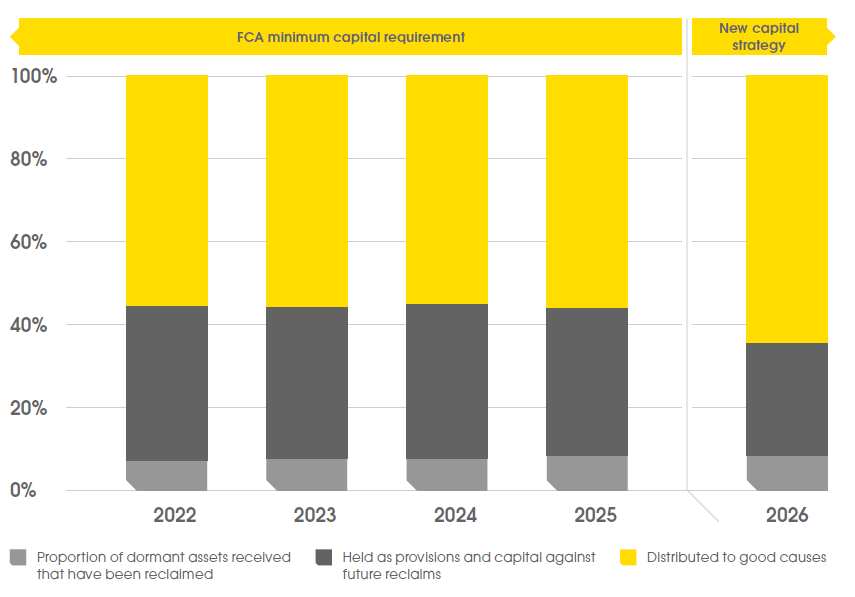
PROPORTION OF DORMANT ASSETS RECEIVED THAT HAVE BEEN RECLAIMED, HELD AS PROVISIONS AND CAPITAL AGAINST FUTURE RECLAIMS, OR DISTRIBUTED TO GOOD CAUSES

Stacked bar chart showing the proportion of dormant assets received that have been reclaimed, held as provisions and capital, or distributed to good causes for years 2022 to 2026. 2022: 8% reclaimed, 36% held, 56% distributed. 2023: 8% reclaimed, 36% held, 56% distributed. 2024: 8% reclaimed, 36% held, 56% distributed. 2025: 8% reclaimed, 36% held, 56% distributed. 2026: 8% reclaimed, 28% held, 64% distributed — reflecting the new capital strategy replacing FCA minimum capital requirements.
Proportion of dormant assets received that have been reclaimed, held as provisions and capital against future reclaims, or distributed to good causes (2022–2026)

PRINCIPAL ACTIVITIES

The principal activity of RFL is the receipt and management of dormant asset monies. It has been actively operating since 28 March 2011.

As set out in the preceding sections, legislation enables eligible organisations to voluntarily transfer dormant assets to RFL and for surplus funds to be distributed to TNLCF and then onward to good causes across the UK. This is known as the Main Scheme. Currently, eligible banks, building societies, insurance and pensions providers, investment and wealth management firms, and UK publicly limited companies can join the Main Scheme.

In addition, RFL operates an Alternative Scheme for smaller banks and building societies with balance sheet assets of less than £7 billion. This enables them to transfer an agreed proportion of a dormant account balance to RFL and the remaining proportion to charities with which they share a special connection, such as those supporting their local communities.

Both Schemes ensure that the right of dormant asset owners, or their beneficiaries, to reclaim their money is protected in perpetuity. It achieves this by transferring the individual’s claim against the financial institution to RFL, ensuring that customers can always get back the equivalent of what they would have received had a transfer into the Scheme not occurred. RFL therefore reserves a prudent proportion of dormant assets to meet any future reclaims.

RFL’s strategy is aligned to the operational activities permitted under the Acts, its Framework Document with HMT as its shareholder, and its Articles of Association. It is permitted under the 2008 Act and its Articles to invest funds and to defray administrative costs and other reasonable expenses.

OUR STORY

RFL commenced operations in 2011, following the passage of the 2008 Act and receipt of regulatory authorisation to act as an authorised reclaim fund. The 2022 Act named RFL as the authorised operator of the UK Dormant Assets Scheme, and it remains its sole operator.

RFL was established by, and originally was a wholly owned subsidiary of, the Co-Operative Group Limited. In late 2019, the Office for National Statistics (ONS) classified RFL as part of the central government sector, effective retrospectively from the point of RFL’s establishment. The shares in RFL were subsequently transferred to the Treasury Solicitor for the Affairs of HMT on 30 March 2021 and RFL became a Non-Departmental Public Body (NDPB), sponsored by HMT. UKGI manages the shareholder relationship on a day-to-day basis, and appoints a Shareholder Representative NED to RFL’s Board.

As an NDPB, RFL has an important role in the processes of the government and works to deliver the Scheme in line with its priorities.

A Framework Document, setting out the broad governance framework within which RFL, HMT, UKGI (in its capacity as representative of HMT) and DCMS (in its joint policy role with HMT) operate, has been agreed between HMT and RFL and has been approved by HMT in accordance with the Managing Public Money handbook. The Framework Document does not, however, convey any legal powers or responsibilities.

More information can be found in the Corporate Governance Statement on page 40

REVIEW OF THE YEAR

AMOUNTS RECEIVED FROM PARTICIPANTS

RFL accepted £271.6 million (2024/25: £164.5 million) of dormant account transfers from 17 of the 44 participating UK Banks and Building Societies in the Main Scheme (2024/25: 19 of 41). The Scheme is voluntary for financial institutions and as such eligible organisations can choose whether to contribute to the Scheme and to what extent. This year has been an exceptional year for Banks and Building Societies in the Main Scheme, experiencing our second-best year for dormant transfers received. Additionally, RFL accepted liability for £0.7 million (2024/25: £1.6 million) of dormant account monies from Alternative Scheme Participants, with three new Participants joining during the year. In late 2025, RFL was pleased to open to a new sector, Investment and Wealth Management, with our first four Participants contributing £0.2 million towards the total value of dormant assets received.

OPERATING COSTS

Operating expenses consist of professional service fees, staff costs, Directors’ fees, investment management fees, and other costs incurred in the normal course of operating an FCA-regulated business and Arm’s Length Body, totalling £5.8 million (2024/25: £5.1 million) in the year. RFL’s business model is built on a combination of in-house operations and outsourced suppliers. The primary driver for the increase in operating expenses is in actuarial fees, which was required to drive our wider capital strategy project and has resulted in our largest distribution to date. Staffing levels are also higher this year as we invested for scheme expansion, leading to an increase in associated costs.

Set-up costs of £1.3 million (2024/25: £1.2 million) have been incurred for Scheme expansion. These include fees for project management, business consultancy, marketing consultation and legal support, in order to embed the new Investment and Wealth Management Participants and future joiners.

RESERVING AND DISTRIBUTIONS

RFL set aside distributions to TNLCF during 2025/26 of £370.3 million (2024/25: £142.8 million), the large increase reflecting both the significant dormant asset contributions from Banks and Building Societies in the year, along with the change to our capital strategy that has allowed for increased distributions to be made. The Board were pleased to approve a distribution of £370.3 million on 8 July 2026, taking cumulative distributions to more than £1.6 billion.

RFL has reported a retained deficit of £125m for the year (2024/25: retained surplus of £14m). The year-on-year movement is principally attributable to the record level of distributions to TNLCF, which, in accordance with IFRS, are recognised as a charge to the Income Statement and therefore give rise to the reported deficit.

The prior year’s surplus reflected the capital management and reserving framework previously determined by the FCA. Had that framework continued to apply in the current year, the resulting retained surplus would have exceeded that reported in 2024/25, rather than moving into deficit.

RFL continues to set aside sufficient funds to meet the level of reclaims it is prudent to anticipate in perpetuity. The best estimate reclaim provision continues to be refined using significant actuarial expertise and has resulted in a reclaim provision of £211.7 million at 31 March 2026 (2024/25: £186.7 million). Further analysis and sensitivities can be seen in Notes 1 and 9.

A number of reclaims were paid to Participants, amounting to £24.7 million (2024/25: £26.0 million). Of the £24.7 million paid in the year, £22.6 million related to dormant assets received to 31 March 2025 and the remaining £2.1 million related to dormant assets received in the year to 31 March 2026. As at 31 March 2025, the best estimate model predicted reclaims of £20.2 million, which is lower than the £24.7 million paid out in the year. RFL investigated the source of higher than expected reclaims and continues to refine the model in light of additional reclaim experience.

At 31 March 2025 reclaims to the value of £1.4 million were outstanding, which contributed to an overall trade payable balance of £3.0 million. This has not been replicated this year, with a full reduction in reclaims outstanding to £nil. The remaining trade payables balance is made up of accruals, and these balances have remained consistent year on year, with the balance at 31 March 2026 being £1.3 million (2024/2025: £1.6 million).

ASSETS UNDER MANAGEMENT

Total Assets have increased £906 million to £1,029 million in the year, reflecting the large inflows of dormant assets in the year, net of distribution and reclaim payments. Of these assets, investment securities have increased by £15.1 million from £467.3 million to £482.4 million at 31 March 2026, as a result of coupons generated from the investment portfolio being re-invested and positive investment returns driven primarily by the covered bond exposure in the investment portfolio.

PARTICIPATION

The Scheme has been open to eligible Banks and Building Societies since 2011 and continues to see good growth in participation from this sector. In 2025/26, we welcomed three new Participants to the Main Scheme.

The 2022 Act expanded the Dormant Assets Scheme to include a range of assets in the insurance and pensions, investment and wealth management, and securities sector. This expansion, which has been implemented in phases, has required patience due to the complexity of the new assets and comprehensive regulatory and procedural changes that were required after the 2022 Act was passed. We have been working closely with the government, FCA, trade associations, and industry stakeholders to identify and implement pragmatic solutions to the challenges posed while continuing to protect dormant asset owners.

The Scheme was first opened to eligible institutions in the insurance and pensions sector in June 2023, and RFL was delighted to welcome Aviva plc and Legal & General as early adopters. We continue to engage with companies in the sector to raise awareness of the Scheme and invite participation.

We also encourage UK public limited companies to consider participating in the Scheme with their dormant shares and share proceeds, where eligible.

In August 2024, the FCA published rule changes that lifted regulatory barriers to participation from the investment and wealth management sector. Following significant work from RFL, we were delighted that the voluntary requirement (VREQ) that had prevented RFL from accepting investment assets was lifted in early 2025. With both the rule changes published and the VREQ lifted, the major hurdles were overcome for this sector and we welcomed four early adopters into the Scheme in Autumn 2025. We continue to work in the market to attract further participation.

While the Scheme offers a unique opportunity both to reunite assets with their owners and to fund vital charitable and community activities at scale, it remains voluntary. As such, its success will be based entirely on eligible institutions’ decision to participate and transfer the eligible assets they hold. RFL stands ready to support potential and current Participants in any way we can to drive continued growth of the Scheme.

BUSINESS REVIEW

KEY PERFORMANCE INDICATORS

During the year, the Board and its Committees have reviewed RFL’s performance through key performance indicators (‘KPIs’), the results of which provide an overview of its Participants, stakeholders, processes and financial strength.

NON-FINANCIAL STATISTICS

PARTICIPANTS

Level of participation in the Scheme by eligible Participants.

During the year to 31 March 2026, amounts were received in respect of dormant assets from 17 of the 44 Main Scheme Participants (2024/25: 19 of 41), from 5 of the 12 Alternative Scheme Participants (2024/25: 8 of 9), and from the 4 new Investment and Wealth Management Participants.

SUPPLIERS

Agreements with outsourced service providers that comply with set service level standards on quality, cost and timeliness.

All outsourced services were supplied to RFL at agreed costs and all services were delivered to standards set out in service level agreements.

PROCESSES

Compliance with regulations and contracts with external parties.

There were no known breaches of any regulations or contracts with external parties during the year.

FINANCIAL KPIS

AMOUNTS RECEIVED FROM PARTICIPANTS

£272.5m

(2024/25: £173.0m)

In 2025/26, transfers exceeded Management’s expectation, taking total transfers since inception to more than £2.4 billion. Contributions were received from two of the four sectors of the Scheme — namely, Banks and Building Societies, and Investment and Wealth Management sectors. The Dormant Assets Scheme is voluntary, with Participants providing indicative transfer forecasts which Management measure performance against.

AMOUNTS SET ASIDE TO SUPPORT THE LONG-TERM BUSINESS

£656.8m

(2024/25: £756.7m)

The total amount reflects both the reclaim provision and the Company’s capital and reserves available to support the long-term viability of the business — i.e. amounts required to meet reclaim in perpetuity under stressed conditions. The Board has determined that RFL holds sufficient capital to run the business in the long term and to meet its internal capital requirements.

ONGOING OPERATING COSTS

£5.7m

(2024/25: £5.1m)

Operating expenses consist of staff costs, Directors’ fees, investment management fees, professional service fees and other costs incurred in the normal course of operating an FCA-regulated business and arm’s length body, totalling £5.7 million (2024/25: £5.1 million) in the year. RFL’s business model is built on a combination of in-house operations and outsourced services. The primary driver for the increase in operating expenses is in actuarial fees, which was necessary to drive our wider capital strategy project and has resulted in our largest distribution to date. Staffing levels are also higher this year as we invested for scheme expansion, leading to an increase in associated costs.

INVESTMENT SECURITIES HELD

£482.4m

(2024/25: £467.3m)

We maintain a highly liquid and secure investment portfolio. In line with our current investment strategy, maturing bonds and coupons generated from the investment portfolio are re-invested in floating rate notes, which results in a change of asset mix between fixed and floating income instruments within investment securities.

SCHEME EXPANSION SET-UP COSTS

£1.3m

(2024/25: £1.2m)

Set-up costs of £1.3 million (2024/25: £1.2 million) have been incurred for Scheme expansion. These include fees for project management, business consultancy, marketing consultancy and legal advice to support the opening to Investment and Wealth Management Participants.

LIQUIDITY — CASH HELD

£545.9m

(2024/25: £438.5m)

RFL predominantly holds cash balances with the Bank of England, which provides a high degree of security and liquidity, with the remaining cash being held by its investment manager.

YOUTH FUTURES FOUNDATION

£2 MILLION TO SUPPORT SUSTAINED EMPLOYMENT

Evidence into Action, one of Youth Futures Foundation’s flagship programmes, works with voluntary sector delivery organisations across England to improve the quality of employment support for young people by applying evidence about what works in practice.

£2 million will support eight frontline organisations over three years to embed strong evidence of what works in delivering on- and off-the-job training, helping more marginalised young people access support that improves their chances of progressing into sustained employment.

One of these organisations is Miss Macaroon, a Birmingham based social enterprise that produces premium, hand made macaroons and reinvests 100% of its profits into helping long term unemployed young people build the skills and confidence they need to enter sustained employment.

Miss Macaroon

Annual report figure — page 27
Miss Macaroon

At Miss Macaroon we’re delighted to be part of the Evidence into Action programme to develop and refine our programmes to better support the young people we serve. Our team is looking forward to continuing our work with Youth Futures Foundation and Action for Race Equality to build our inclusive practice and share this best practice with our corporate partners to provide even more training and job opportunities for local young people.

— ROSIE GINDAY MBE, CEO AND FOUNDER OF MISS MACAROON

SECTION 172 STATEMENT

DIRECTORS’ DUTY TO RFL’S WIDER STAKEHOLDER BASE

RFL’s unique status as an authorised reclaim fund is constituted in accordance with the Acts. The Directors of RFL have a duty to act in a manner that they consider in good faith will best achieve RFL’s purpose.

The Board is acutely aware of its responsibilities to ensure the long-term success of RFL, and to demonstrate its alignment to the Section 172 statement required by the Companies Act 2006.

The Board has analysed the wider stakeholder base and has considered each stakeholder.

“Santander see participation in the Dormant Assets Scheme as a way of providing security and certainty for our customers, whilst removing any ambiguity as to how to manage dormant funds internally. Having a clear and consistent journey that we can point both our customers and colleagues towards, which is highly effective at reuniting customers with their funds even after long periods of time, is a win-win scenario which benefits everyone who uses the process.”

— MATTHEW TURNER, RISK AND CONTROL MANAGER, SANTANDER

DORMANT ASSET OWNERS

Sufficient funds must be retained and available to meet customer reclaims of any dormant asset balances in perpetuity.

As a result, careful analysis, including extensive work on reclaim modelling, has been undertaken to ensure dormant balance transfers to RFL from Participants are protected and invested prudently to meet any and all future obligations.

SCHEME BENEFICIARIES

RFL’s purpose is to unlock the potential of dormant assets to enhance communities and enrich lives.

This is achieved by transferring surplus funds not required to cover future reclaims and its capital requirements to TNLFC, which then distributes funding to good causes. RFL communicates the benefits of the Scheme through its regular newsletter, website, and social media, as well as in discussions with prospective and current Participants. The Board agreed at the 8 July 2026 meeting to release a further £370.3 million to TNLFC to benefit good causes, taking the total value that RFL has unlocked to over £1.6 billion since 2011.
GOVERNMENT

UK Government Investments (‘UKGI’) is part of the sponsorship of RFL, by acting as the shareholder representative on behalf of HMT.

UKGI works with HMT and RFL to promote effective corporate governance; to monitor and challenge business planning and performance; to promote strong corporate capability and effective leadership; and to support effective relationships between RFL and HMT. UKGI provides advice to HMT and Ministers on these matters and provides a Shareholder Non-Executive Director to the Board.

In addition to engaging with HMT as our Shareholder, RFL continues to engage closely with our government policy stakeholders, most notably HMT and DCMS, with regular communications via senior Management. We have collaborated closely on opening the Scheme to the Investment and Wealth Management sector, including a roundtable led by the Chancellor to encourage early adoption, a follow-up discussion with Transfer Agents, and a joint visit to celebrate its launch. We continue to work together with DCMS on driving participation from eligible institutions.

SCHEME PARTICIPANTS

RFL has regular communication with Scheme Participants, and provides proactive support for Scheme onboarding, transfers, and reclaims.

This includes, but is not limited to, regular meetings, the annual self-certification process, and introductions to other Participants to share experiences and best practices. RFL also participates in selected third-party events, such as annual conferences run by the Building Societies Association, Association of British Insurers, the Investment Association, and Pensions UK.

OUR REGULATOR

The Company is regulated by the FCA, RFL’s Chief Executive and Chief Risk Officer maintain regular contact with RFL’s FCA supervisor on regulatory and supervisory matters.

The Board and Management have put robust systems and controls in place, which are regularly reviewed for effectiveness, to ensure that RFL continues to operate within its regulatory framework.

ENVIRONMENT

RFL is committed to managing its use of resources and its environmental impact.

The Board and Executive continue to focus on the impact of RFL’s core activities, notably the impact of its investment activities, people and suppliers. The Company will continue to review climate change regulation and adapt its operations where necessary to ensure its work aligns to its purpose, mission and values. The Board has defined the company’s sustainability risk and risk appetite statement in RFL’s Sustainability Framework. More information can be found in the Sustainability Report on page 28.

EMPLOYEES

RFL has a small, highly professional permanent team, complemented by contract proof staff, and outsources several activities to specialist third parties.

Staff engagement is strong, an open culture is encouraged, and the Board supports Management’s investment in its workforce, including support for training and development. RFL adopts a flexible, hybrid working policy, whilst leveraging the office as a collaborative hub. RFL has been awarded a gold standard ‘We Invest in Wellbeing’ award, has Investors in People Gold status, and continues to be accredited as a Living Wage employer.

CAPITAL & RESERVING

RFL has led a project to review and refresh its approach to calculating provisions and capital reserves for dormant bank and building society accounts in order to determine how much can be distributed to good causes. This project was undertaken during the year and successfully brought together a broad range of stakeholders, including Government, regulator, shareholder, fostering strong collaboration and delivering significant financial outcomes, with substantial funds released and distributed to support a wide range of scheme beneficiaries.
OUR SUPPLIERS

We rely on a range of key suppliers to support our operations, including technology and professional services.

Our procurement processes are aligned with the principles of the Procurement Act 2023 and the expectations set out in Managing Public Money, ensuring that all procurement activity is conducted with transparency, fairness and value for money. Key suppliers are subject to regular supplier review, including formal annual reviews for our most critical suppliers, to assess performance and ensure ongoing compliance with our contractual, regulatory and ethical standards – including the Modern Slavery Act, GDPR and other applicable requirements. We are committed to maintaining responsible and secure supply chains that align with our company values. In January 2026, RFL was once again awarded the Good Business Pays C1C ‘Fast Pay Award’, which recognises those with the best supplier payment performance over the past year. To win this award, a business must pay suppliers in less than 27 days (on average) and pay over 95% of their invoices or more on time over a 12-month period.

SUSTAINABILITY REPORT

OUR ESG COMMITMENTS

RFL has an exemption from the UK Government Greening Commitments reporting, as an Arm’s Length Body with an operational footprint below the required threshold of 50 employees and an office size under 500m². RFL is committed to supporting sustainability and therefore chooses to disclose its environmental, social and governance (‘ESG’) commitments on a voluntary basis.

RFL has assessed its energy consumption against energy and carbon criteria in The Large and Medium-sized Companies and Groups (Accounts and Reports) Regulations 2008, and it is under the 40,000 kWh minimum criteria. RFL has therefore taken the decision to omit these disclosures from the Sustainability Report.

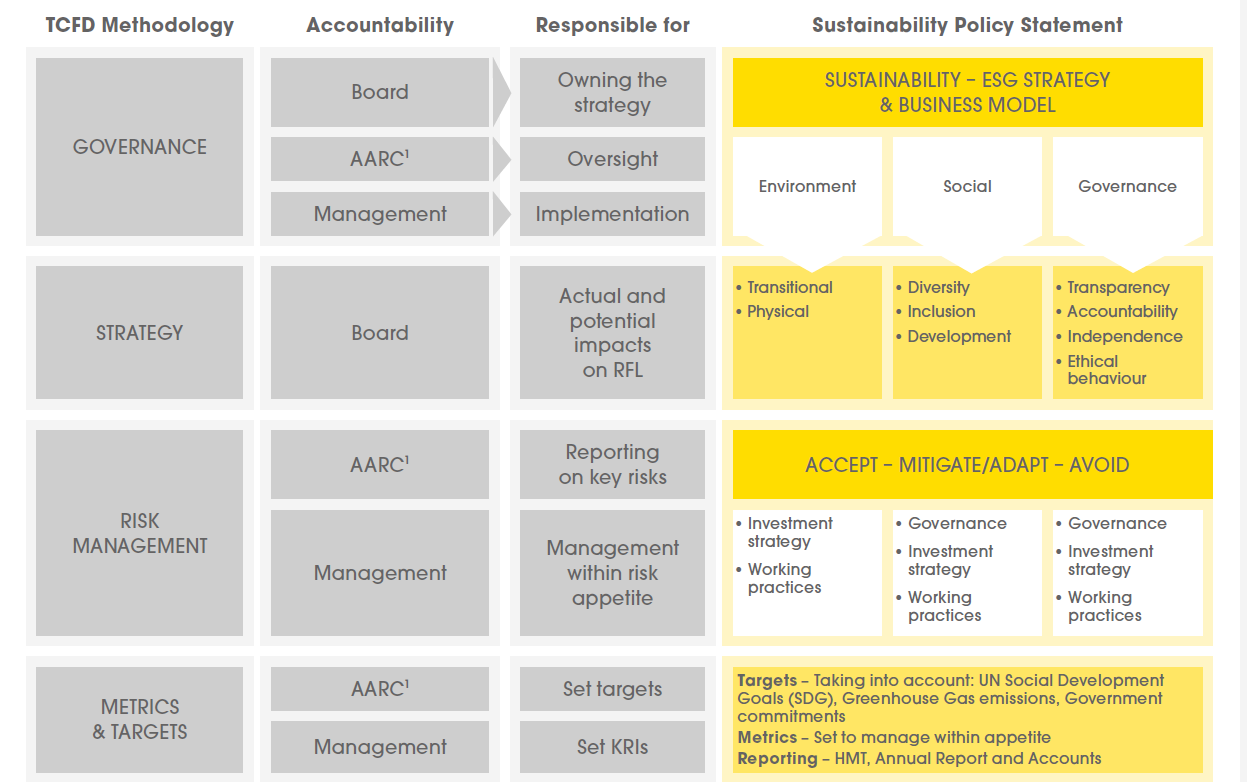
The Board of RFL has taken the approach of setting out its Sustainability Framework, incorporating ESG elements, with a high-level policy statement outlining RFL’s risk appetite and targets. This is outlined in the diagram below.

RFL uses the Task Force on Climate-related Financial Disclosures (‘TCFD’) framework to cover all three ESG elements.

SUSTAINABILITY FRAMEWORK

RFL Sustainability Framework diagram showing the four TCFD methodology pillars (Governance, Strategy, Risk Management, Metrics & Targets) with accountability, responsibilities, and the Sustainability ESG Strategy & Business Model. Key elements include Environment (transitional, physical), Social (diversity, inclusion, development), and Governance (transparency, accountability, independence, ethical behaviour), with a risk approach of ACCEPT – MITIGATE/ADAPT – AVOID.
Sustainability Framework — TCFD methodology, accountability, responsibilities, and ESG strategy

OUR ESG COMMITMENTS CONTINUED

KEY ELEMENTS OF RFL’S SUSTAINABILITY POLICY

The Board has defined what sustainability risk means to the Company and its appetite for risk in this area, and has implemented a robust governance framework, including key targets and metrics, to ensure RFL operates in line with its defined sustainability risk appetite. The Board continues to reassess and evaluate progress and the suitability of the framework on a regular basis.

Definition of sustainability risk: “An uncertain social, governance or environmental event or condition that, if it occurs, can cause significant negative impact on the Company.”

Risk appetite statement: “The Board has limited appetite for activities that could impact RFL’s journey to a sustainable position, this being aligned to the UK Government’s Net Zero by 2050 target, the ‘Paris Agreement’ and the Financial Conduct Authority’s Social and Governance aims on diversity and inclusion.”

Risk assessment: The Board, supported by Management, has carried out a risk assessment across the three elements of ESG to identify where RFL can have a material impact. This disclosure focuses primarily on the following:

  • environmental: transition, physical and litigation risk factors and related opportunities
  • social: adherence of RFL and it’s supply chain partners to RFL’s modern slavery policy; achievement of the Fast Supplier Payments accreditation; and a measure of RFL as an employer based on Investors in People and Living Wage accreditations
  • governance: consideration of diversity at Board level and compliance with the Corporate Governance Code.

SUSTAINABILITY FRAMEWORK

The elements of the framework are set out below:

GOVERNANCE

The Board owns RFL’s Sustainability Framework and provides oversight of the risks, opportunities, and performance against targets. Responsibilities are differentiated from Board Committees through to Management which carries out the day-to-day assessment and management of sustainability-related risks and opportunities.

STRATEGY

The Board has assessed the RFL-specific risks and opportunities over the short, medium, and long term. In carrying out this assessment, RFL ensures that its investment mandate and sustainability targets are aligned and that any changes to operations and investment management are proportionate, manageable, and cost-effective.

RISK MANAGEMENT

The Board integrates these risks and opportunities into RFL’s Risk Management Framework in order to ensure that they are assessed and managed appropriately and considered in RFL’s Capital Adequacy Review Process (‘CAR’) and Operating Plan.

Metrics and targets

RFL’s ESG targets are reviewed and approved by the RFL Board each year and are split between RFL’s investment portfolio and governance and operational targets. A comparison of actual performance to these targets is tracked by Management and Board, with performance ahead of target for the majority of metrics. The target ranges aims to meet the Government’s Net Zero by 2050 commitment.

RFL is keenly aware of the importance of diversity at senior levels in the organisation and will continue to consider the gender and ethnicity balance in making recommendations for future appointments and actively seeking a diverse pool of candidates for interview.

SUSTAINABILITY REPORT

OUR ESG COMMITMENTS CONTINUED

The table below shows the position as at 31 March 2026.

RFL 2022 to 2050 target rangeRFL position at 31 March 2026Status
Investment portfolio
Environmental – Overall MSCI rating26.4 (A) increasing to 10 (AAA)7.7 (AA)On track
Social – Overall MSCI rating5.0 (BBB) increasing to 8.6 (AA)5.0 (BBB)On track
Governance – Overall MSCI rating5.0 (BBB) increasing to 8.6 (AA)7.0 (A)On track
RFL governance and operations
Environmental – Greenhouse gas emissionsRFL has an immaterial Greenhouse gas operational footprintRFL has an immaterial Greenhouse gas operational footprintOn track
Social – modern slaveryKey supply chain monitoring of adherence to supply code of conductBased on RFL’s active monitoring, RFL is unaware of any modern slavery concerns within its current supply chainOn track
Social – Supplier Fast PaymentAnnual Achievement of Fast Payer AccreditationAchieved in December 2025On track
Social – Employment MeasureAnnual Achievement of Investors in People and Living Wage AccreditationsAchieved in July 2025On track
Governance – % women on Board3≥40%38%Monitoring
Governance – Ethnic minority representation on the Board≥13On track
Governance – Compliance with Corporate Governance CodeAnnual ConfirmationAchievedOn track

1 tCO2e/SMM is defined as tonnes (t’) of carbon dioxide (‘CO2’) equivalent (e) per USD millions of revenue.

2 MSCI ESG ratings aim to measure a company’s management of financially-relevant ESG risks and opportunities. MSCI uses a rules-based methodology to identify industry leaders and less advanced companies according to their exposure to ESG risks and how well they manage those risks relative to peers. Their ESG ratings range from leader (AAA, AA) to average (A, BBB, BB) and less advanced (B, CCC).

3 When considering gender balance among the Non-Executive Directors, female representation on the Board stands at 43%, exceeding the FCA’s target.

RISK MANAGEMENT

EVALUATING AND MANAGING RISKS

Risk management is the process of identifying, evaluating, and managing risks in order to reduce threats and take opportunities in support of delivering RFL’s strategy.

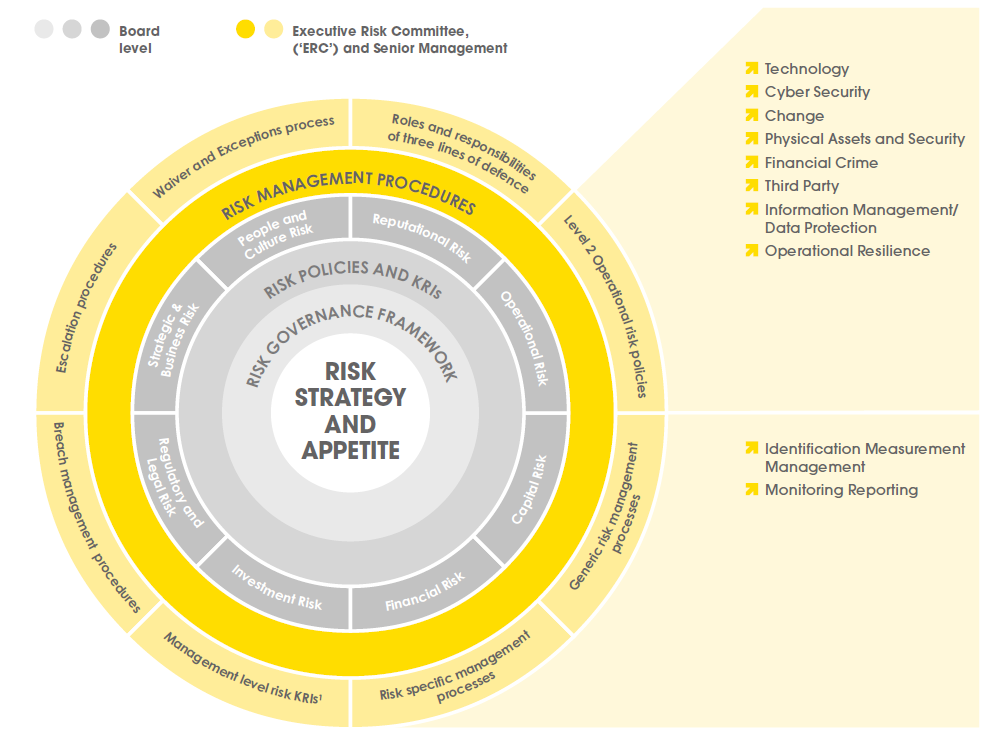
OUR RISK MANAGEMENT FRAMEWORK

The Board is responsible for setting RFL’s risk appetite and ensuring that appropriate risk management systems are in place. The Board reviews the Risk Management Framework throughout the year as part of its rolling agenda and regularly assesses the principal risks. This approach facilitates a common, RFL wide approach to the identification, analysis, and assessment of risks, including the way they are managed, controlled, and monitored. Throughout the year, RFL has managed its risks to ensure that it complies with the Acts and other relevant legislation.

RFL Risk Management Framework diagram. A concentric circle diagram with RISK STRATEGY AND APPETITE at the centre, surrounded by rings: RISK GOVERNANCE FRAMEWORK, RISK POLICIES AND KRIs, eight risk categories (People and Culture, Reputational, Operational, Capital, Financial, Investment, Regulatory and Legal, Strategic & Business), RISK MANAGEMENT PROCEDURES, and specific procedures (three lines of defence, operational risk policies, risk management processes, KRIs, breach management, escalation, waivers). Right side lists: Technology, Cyber Security, Change, Physical Assets, Financial Crime, Third Party, Information Management, Operational Resilience — and Identification, Measurement, Management, Monitoring, Reporting.
Risk Management Framework — concentric model showing governance, policies, risk categories, and operational procedures

1 KRI = Key risk indicator.

RISK MANAGEMENT

EVALUATING AND MANAGING RISKS CONTINUED

PRINCIPAL RISKS AND UNCERTAINTIES

RFL operates in a regulated environment and is subject to legislative and regulatory requirements, with the sole regulator being the FCA. In line with the requirements of the Acts, the Board is responsible for strategy, risk, and overall corporate governance. This also includes ensuring that there are adequate systems of risk management in place, and that the level of capital held is consistent with the risk profile of the business and meets the Board and Shareholder Risk Appetite.

RISK MANAGEMENT RESPONSIBILITIES

Whilst the Board retains ownership of risk management, day-to-day responsibility is delegated to the Chief Executive, supported by the Executive team. This includes the identification, evaluation, and monitoring of key risks and the implementation of RFL-wide risk management processes and controls.

The Executive team is supported in this by the Executive Risk Committee (ERC), which reviews the effectiveness of RFL’s risk management and controls systems and reports to the Board on the results of its review. The occurrence of any material control issues; serious incidents; major commercial, financial or reputational issues; or new emerging risks is considered by the ERC and reported to the Audit and Risk Committee (AARC) and Board as appropriate on a timely basis.

HOW WE MANAGE RISK

RFL’s Risk & Compliance Function manages the Risk Management Framework, which provides guidance to RFL staff on RFL’s risk appetite and how risks should be managed. During the year, RFL has procured a Risk Management System to enhance the recording and analysis of its risks and controls, as well as enhancing its Risk Management Framework by introducing techniques such as an Emerging Risk process and improving action and incident management. RFL uses a three lines of defence’ model through which it manages significant risks, overseen by the Board and AARC:

First line: Risk and control ownership by the business is part of day-to-day operations, under the direction of the Executive team.

Second line: RFL’s Risk and Compliance function, under the direction of the Chief Risk Officer (CRO), provides oversight of business activities, assesses risk across the business on a regular basis, and provides guidance on the application of risk management. The Second Line reports on a regular basis to the Board and AARC, and the CRO has direct access to the Chair of the AARC at any time.

Third line: Independent assurance over RFL’s risk management, control, and governance processes is provided by RFL’s internal audit service provider, Deloitte LLP, which has a direct reporting line to AARC.

KEY RISKS IN 2025/26

RFL is exposed to various risks both internally and externally. Through both first and second line activities, Management provides oversight of these risks. Where these risks have the potential to go beyond their acceptable risk threshold, Management takes decisive action to ensure the likelihood of these risk materialising is mitigated as far as possible.

RFL’s principal risk categories are shown in the table below. Some of the key drivers of these principal risk categories are as follows:

1. Macro-economic instability impacts RFL from a strategic and operational perspective. The level of geo-political uncertainty remains high, with uncertain outcomes. Whilst RFL has managed the impacts of this risk effectively over recent years, if it crystallised, this risk could lead to higher reclaim rates, volatility in investment performance and increased operational costs.

2. The expansion of the Dormant Assets Scheme in line with the 2022 Act, continues to drive a significant amount of change, particularly in relation to the opening to the Investments & Wealth Management sector. For example:

• the FCA has requested that RFL takes significant steps to manage dormant assets if a participating firm is subject to a disorderly insolvency with no successor to take on the obligations of their Transfer and Agency Agreement (‘TAA’). This would have considerable implications for RFL’s operating model, with RFL becoming a business-to-customer operation, which would be subject to increased regulatory requirements such as Consumer Duty.

• should RFL take on different asset classes, such as investment assets with a fluctuating reclaim value, RFL would be required to adopt new ways of managing, monitoring, and reserving for these funds.

Both these examples would require RFL to make substantial operational changes, which RFL continues to plan for and work towards.

3. RFL faces significant stakeholder interest on various matters including the speed of opening to new sectors, the approach to new assets classes, and the revised capital and reserving approach. This in turn drives risk, including reputational risk, should the needs of different stakeholder groups not be met.

Management monitors these drivers carefully and takes necessary action to manage risks within the agreed risk appetite.

EVALUATING AND MANAGING RISKS CONTINUED

PRINCIPAL RISKS

The table below sets out the principal risks that have an impact on our strategy and objectives.

Principal risk Detail Trend Mitigations
Strategic and business risk

Strategic and business risk is defined as the risk of not being able to deliver RFL’s Operating Plan and desired strategy.

Strategic risk also encompasses RFL’s exposure to a wide range of macro-economic, geo-political, banking, regulatory, and other external risks, particularly relating to dormant assets.

RFL’s risk exposure is assessed as increasing compared with last year. This reflects heightened geo-political uncertainty, and could impact the Government’s strategic approach to the Dormant Assets Scheme and/or RFL as an Arm’s Length Body. It also reflects the complexity of implementing the Scheme expansion, where RFL continues to face challenges in securing firms’ time, resource, and motivation to prioritise participation over compulsory or revenue-raising activities.

Increasing
  • The Board and Executive continually consider the impact of current events on RFL’s strategic objectives.
  • Management undertakes horizon scanning for future developments which could impact on RFL and develops actions where needed.
  • RFL has now carved out a new Executive role overseeing Scheme expansion and Government engagement. This approach, and the resulting Development function, ensures these areas receive dedicated focus within the business to drive progress and identify and mitigate risk wherever possible.
  • RFL continues to build and maintain strategic relationships with our key stakeholders. This includes proactive engagement with Ministers, Departmental officials, Regulators, etc., which allows a developed understanding of political, strategic, and business priorities as they evolve.
Regulatory and legal risk

RFL operates in a regulated environment and is subject to significant legislative requirements. By having the unique classification of ‘Dormant Account Fund Operator’, it is regulated by the FCA with specific regulatory obligations.

RFL’s risk exposure is assessed as stable, based on the transparent relationship we have built with the regulator.

Stable
  • Communication and collaboration with the regulator on any proposed internal or external material changes.
  • RFL uses a combination of in-house and external regulatory and legal experts to ensure proactive compliance with relevant regulations and legislation.
Operational risk

Operational risk is defined as the risk of loss resulting from inadequate or failed internal processes, people, systems, or external events.

Amongst RFL’s operational risks, and as with all other financial organisations, RFL faces cyber security threats which continue to evolve and have the potential to disrupt RFL’s operations if they materialised.

RFL’s operational risk exposure remains stable, following delivery of a number of key projects in the year, and recruitment of key members of staff.

Stable
  • Twice-yearly Risk and Control Self-Assessment (‘RCSA’) completed by second line and approved by AARC. The RCSA attests to the effectiveness of RFL’s control environment against its identified risks.
  • Regular review of preventative and detective controls.
  • Second-line review of RFL operations and any proposed changes.
  • Early involvement of second line in all relevant operational initiatives.
  • Use of external specialists to address specific risks and provide third-line internal audit reviews.
  • Introduction of improved technology to reduce reliance on individuals and provide scalability.
  • Refined organisation design and new appointments to increase organisational depth, capacity, and expertise.
  • Cyber strategy in place to anticipate and respond to cyber threats, supported by external assurance over controls, including Cyber Essentials Plus accreditation.

RISK MANAGEMENT

Evaluating and managing risks continued

Principal risk Detail Trend Mitigations
Change risk

Change risk is defined as the risk of relying on a small core RFL team to deliver and absorb the level of change created by strategic initiatives, most notably Scheme expansion.

While the completion of the implementation of a Customer Relationship Management and new risk systems, and finalisation of the Reserving and Capital Project, has seen some sources of this risk improve, Change risk is considered to be rising overall. This is due to the significant operational complexity involved in bringing the contingent insolvency solution onto standby mode, as well as substantial technical work to accept collective scheme investment assets with a fluctuating reclaim value in due course. It also acknowledges significant staff change at RFL, including at Executive level, over the past year.

Increasing
  • Use of external specialists to provide advice and guidance on more complex aspects of Scheme expansion.
  • Refined organisation structure and new appointments to increase organisational knowledge, capacity, and expertise.
  • Regular monitoring of change delivery, risks, and issues by Executive team.
  • Development of a dedicated change function and change framework, alongside a detailed Investment & Wealth Management project plan that is regularly monitored and reviewed by the Executive team and Board.
Financial risk

Financial risk is defined as the risk that cash flow may not be available to pay obligations when due.

Financial risk is also defined as the risk that statutory financial reporting is materially mis-stated.

Financial risk remains stable due to effective cash management and robust financial reporting controls.

Stable
  • RFL’s policy is to ensure it has sufficient funds to fulfil liabilities as they fall due.
  • RFL operates within a robust financial control environment, including appropriate segregation of duties and review.
  • All financial regulatory reporting is approved by the CFO and CEO before being submitted. The AARC and Board also review and approve the Annual Report and Accounts prior to submission to the regulator.
Investment risk

Investment risk is defined as the monetary loss due to fluctuations in the level and volatility of market prices of assets and the credit standing of issuers of securities.

Recent geo-political developments in the Middle East have led to a period of heightened uncertainty across global markets. RFL’s investment securities are underpinned by a strict and cautious investment mandate, with purchases being restricted to investments graded no lower than BBB+ and concentrated in high-quality bank issuers. Whilst recessionary circumstances could put pressure on issuers and prompt asset impairments, potentially resulting in credit downgrades, the extent and severity of an economic downturn would need to be significant given the robustness of the financial sector to previous episodes of market stress. RFL’s investment strategy also focuses on the purchase of covered bonds, which by nature have a dual-recourse. These factors help to enhance the robustness of RFL’s investments to the impact of any market uncertainty and investment risk.

Investment risk remains stable as it continues to be mitigated through effective cash management and investment oversight.

Stable
  • The Board has delegated responsibility for overseeing the investment mandate and reporting an experienced Investment Committee.
  • RFL outsources its investment management to a respected fund manager.
  • Investment decisions are made in line with a strict investment mandate in order to manage RFL’s exposure to credit risk. RFL actively reviews this mandate, working closely with the outsourced investment manager.
  • Any downgrading of investments is considered by our investment manager and by the Executive to determine whether it remains appropriate to continue to hold the affected investments, with the Investment Committee informed of the decision.

EVALUATING AND MANAGING RISKS CONTINUED

Principal risk Detail Trend Mitigations
Capital risk

Capital risk is defined as the risk that RFL does not hold appropriate levels of capital to withstand fluctuations in its assets and liabilities and is therefore unable to pay either reclaims as they fall due or long-term operating costs.

RFL recognises the increased risk from the new asset classes where, in contrast to our experience with Banks and Building Societies, reclaim behaviour patterns are less established.

Following the FCA’s confirmation in December 2024 that it no longer has a role in setting RFL’s minimum capital requirement, Management has undertaken a significant reserving and capital project to ensure that RFL holds appropriate capital in line with both Board and Shareholder risk appetite.

Capital risk remains stable due to effective management of cash flows.

Stable
  • RFL’s policy is to maintain prudent reclaim provisions and capital for future reclaims to reflect the uncertainty and longevity of the risk of reclaim.
  • The level of reclaims is rigorously monitored on an ongoing basis and RFL continues to use actuarial expertise to consider stress events that could lead to an increase in reclaim rates.
  • Management has finalised the revised reserving and capital strategy, which replaces the minimum capital requirement previously set by the FCA with a Target Capital requirement, which is calculated by our actuarial advisors, WTW, using the Reclaim Risk Model.
  • Prior to the annual distribution being approved, the AARC and Board review and approve the Risk-Based Balance Sheet report prepared by WTW, which sets out the calculation of RFL’s required provisions and capital under the new capital strategy, and the proposed distribution amount.
  • Alongside this, the AARC and Board review the Capital Adequacy Review (‘CAR’) report, which considers RFL’s projected balance sheet under base and stressed conditions to aid understanding of how RFL’s key risks may impact its capital position and business plan over the forecast horizon, to support capital management and the annual distribution decision.
  • Management has developed a Quality Assurance Framework, which is periodically reviewed by the AARC. Alongside the framework, Management also maintain a Quality Assurance Plan for all components of the Reclaim Risk Model. The plan is approved by the AARC annually and ensures appropriate quality assurance and effective model governance are in place.
Reputational risk

Reputational Risk is defined as the risk associated with an event that, in some way, could be damaging to RFL’s reputation among all or any stakeholders. It can be driven by RFL’s own actions or by the actions and activities of other stakeholders and parties within the Dormant Assets ecosystem.

RFL recognises that with Government, industry, and consumer group interest in relation to its activities, including the speed of opening of new sectors and of monies flowing to good causes, it is exposed to reputational risks if expectations are not met.

Stable
  • The Board provides close oversight of key projects, progress and risks, with action taken where necessary.
  • Management works closely with stakeholders to ensure that expectations are understood and stakeholders are kept up-to-date with progress.

The Strategic Report on pages 2 to 35 is approved by the Directors

Signature of Adrian Smith OBE
Adrian Smith OBE signature

ADRIAN SMITH

Chief Executive

8 July 2026

GOVERNANCE

CONTENTS

Introducing our Board Go to page 37

The Board Go to page 38

Corporate Governance statement Go to page 40

Remuneration and Staff report Go to page 49

Directors’ report Go to page 55

Statement of Directors’ and Go to page 56

Accounting Officer’s responsibilitiesGo to page 57

Parliamentary Accountability and Audit report Go to page 58

Independent Auditor’s report Go to page 59

INTRODUCING OUR BOARD IN ACTION

Board members in a meeting — three directors seated at a table with laptops and water bottles, engaged in discussion
Board meeting — strategic discussion
Board member portrait — male director with white hair
Board member in discussion
Board members around a conference table — three directors with laptops
Board meeting — governance review

To ensure the successful delivery of the Company’s strategy, the Board consists of Directors with a wide range of relevant skills, knowledge, and experience. RFL remains committed to promoting diversity in its broadest sense in Board and leadership recruitment processes, and has improved its gender balance from last year.

BOARD COMPOSITION

Female - 3
Male - 5

INTRODUCING OUR BOARD

OUR COMMITTEES AND COMMITTEE CHAIRS

The Board has delegated certain responsibilities to the four Committees detailed below, each of which has written terms of reference covering the authority delegated to it by the Board. Each Committee has a role in ensuring RFL’s effectiveness.

The Audit and Risk Committee assists the Board in fulfilling its oversight responsibilities for the financial reporting process, including review of the Annual Report and Accounts, systems of internal control, risk management, the internal capital adequacy assessment process, and internal and external audit. Its remit also includes matters relating to whistleblowing and compliance with applicable regulations and legislation, including the Acts.

The Investment Committee supports the Board and the Chief Executive in the development and implementation of the RFL Investment Strategy. It also monitors the ongoing performance and compliance of the outsourced investment manager and custodian and ensures adherence to the Board-agreed investment mandate.

The Nomination Committee supports the process for Board appointments, ensuring a rigorous search and selection process based on its evaluation of the balance of skills, knowledge, and experience required on the Board. HMT Ministers appoint the Chair of the Board after reasonable prior consultation with the Company’s Nomination Committee and Board. The Nomination Committee also considers succession planning for the Board and the Senior Management and the induction programme for new Directors.

The Remuneration Committee considers and approves the remuneration arrangements for the Chair, the Executive Director, and Senior Management.

GOVERNANCE FRAMEWORK FOR THE BOARD OF DIRECTORS

Audit and Risk Committee

The Audit and Risk Committee is chaired by Judith Buttigieg.

Investment Committee

The Investment Committee is chaired by Donal Quaid.

Nomination Committee

The Nomination Committee is chaired by Lawrence M. Weiss.

Remuneration Committee

The Remuneration Committee is chaired by Jenny Watson.

GOVERNANCE

THE BOARD

AS AT 31 MARCH 2026

At the date of the approval of the Annual Report and Accounts, the Board of Directors was comprised as follows.

Board governance chart showing committee structure with Audit and Risk, Investment, Nomination, and Remuneration Committees reporting to the Board
Lawrence M. Weiss, Chair

LAWRENCE M. WEISS

BA (Hons), MIA

Chair

Appointed: 11 July 2023

Experience: Lawrence has held a number of senior Board and executive roles across the financial services and international trade sectors. In addition to his private sector Non-Executive Board positions, he has served as a Board member of UK Export Finance, the UK’s export credit agency, where he also chaired the Audit Committee, and was a member of the Audit and Risk Committee of the Department for International Trade. He was previously Chief Executive Officer of Bank Leumi (UK) plc, where he also chaired its subsidiary companies. Prior to this, he spent nearly two decades at Glencore UK Ltd., holding several senior leadership positions, including Chief Global Credit Risk Officer for the Energy Group, and Chief Financial Officer and subsequently Chief Executive Officer of TMR Energy Ltd, a joint venture between Glencore and TOTAL S.A. During this time, he also chaired both the Trustees of the company’s Pension Scheme and the Glencore Foundation for Education and Welfare. Lawrence began his career at The Chase Manhattan Bank where he rose to become a Director of Chase Investment Bank Ltd, one of the European market leaders in syndicated lending and project finance.

Board governance chart showing committee structure
ADRIAN SMITH OBE, Chief Executive

ADRIAN SMITH

OBE, MBA

Chief Executive

Appointed: 16 November 2010

Experience: Adrian helped establish Reclaim Fund Ltd during 2009/10 and was subsequently appointed as Chief Executive. With a career in retail banking, he previously held senior leadership roles at Co-operative Banking Group, Britannia Building Society, Bank of Ireland and Bristol & West Building Society and was a former Non-Executive Director of Mutual Plus Ltd. He is currently Chair of the Association of Chief Executives, Vice Chair of Plunkett UK and Chair of his local Parish Council. Adrian was awarded an OBE for services to the financial sector in 2022.

Board of Directors group photograph
Judith Buttigieg

JUDITH BUTTIGIEG

MA (Oxon), FCA

Non-Executive Director

A I

Appointed: 13 February 2023

Experience: Judith is a Fellow of the Institute of Chartered Accountants and is CEO of Aviva International Insurance Ltd, Aviva plc group’s internal reinsurer, and a member of its Board of Directors. Judith has over 30 years’ experience in financial services and has held a number of senior executive positions within the Aviva plc group. She has also served as Non-Executive Trustee Director and Chair of the Audit, Operations & Governance Committee for the R&AC Pension Scheme. Judith became Chair of RFL’s Audit and Risk Committee in July 2023.

Board member photo
Rubaba Khan

RUBABA KHAN

BSc, MSc

Shareholder appointed

Non-Executive Director

A N R

Appointed: 1 September 2025

Experience: Rubaba is an Executive Director at UKGI. Since joining UKGI in 2018, Rubaba has advised government departments on a range of corporate finance projects. She led the set-up of the Financial Instruments and Transactions Advisory Group in 2021 and has been leading the UKGI shareholder team for the Nuclear Decommissioning Authority since 2022. Prior to joining UKGI, Rubaba was advising financial institutions at investment banks including Barclays, Nomura and Lehman Brothers.

Board member photo
Colin Ledlie

COLIN LEDLIE

MA FFA C. Act CERA

Non-Executive Director

A I

Appointed: 24 February 2025

Experience: Colin is an experienced actuary and risk professional with over 30 years’ experience in the insurance industry. Colin is a Non-Executive Director at Liverpool Victoria and was previously a Non-Executive Director at Bupa, ReAssure and the National Records of Scotland. His executive career was with Standard Life where roles included Chief Actuary and Chief Risk Officer. He is also a charity trustee at Transition Edinburgh South.

Portrait of a Board member — professional headshot in dark suit with sage green tie against black background
Donal Quaid

DONAL QUAID

CFA, MBA, MSc

Non-Executive Director

I

Appointed: 30 August 2022

Experience: Donal has been Group Treasurer of NatWest Group since December 2019. Previous roles include Head of Derivatives & FX and Head of Treasury Markets, and he has over 25 years’ experience working in capital markets across various treasury, trading, and risk management leadership roles. Donal sits on the Advisory Council of the Financial Markets Standards Board (‘FMSB’). Donal became Chair of RFL’s Investment Committee in August 2022.

Board member photo
Saleh Saeed

SALEH SAEED

OBE

Non-Executive Director

N

Appointed: 14 December 2022

Experience: Saleh has served as Chief Executive of the Disasters Emergency Committee (‘DEC’) since 2012, leading collectively UK responses to global crises and raising over £1.3 billion through 17 national appeals. He previously held senior NGO roles, including Chief Executive of Islamic Relief Worldwide, and has led UK public sector programmes on health inequalities and digital inclusion. He was awarded an OBE in 2013 and an Honorary Doctorate from Birmingham City University in 2019. He is a former Chair of the Emergencies Appeals Alliance and a Non-Executive Director of University Hospitals Birmingham.

Board member photo
Jenny Watson

JENNY WATSON

CBE, BA, MA

Senior Independent Director

A N R

Appointed: 3 January 2019

Experience: Jenny is Chair of the Independent Press Standards Organisation (‘IPSO’) and Broadland Housing Association, and is Deputy Chair of Council at the University of East Anglia. She started her career in the not-for-profit sector and has served as a board member of a number of public bodies, including as a past Chair of both the Faculty Opportunities Commission and the Electoral Commission. Jenny was appointed Senior Independent Director in November 2023.

GOVERNANCE

CORPORATE GOVERNANCE STATEMENT

The Board is responsible for leading and directing RFL in a manner that promotes its long-term success and ensures it operates in the best interests of its stakeholders, including the Shareholder, the Scheme Participants, and RFL’s employees, among others. The Board recognises that high standards of corporate governance are fundamental to the effective discharge of these responsibilities.

RFL has always strived for the highest standards of corporate governance. Since inception, RFL has voluntarily applied principles and provisions of the UK Corporate Governance Code 2024 (‘the Code’). As part of the Governance arrangements following the change in ownership from the Co-op Group to HMT, RFL is formally required to adhere to the Code.

The Board has considered the most recent changes to the Code and has taken appropriate steps to ensure continued compliance with the Code. The Board recognises that the Code is applied on a ‘comply or explain’ basis, allowing for proportionate and transparent application. Were RFL to depart from specific provisions of the code, these would be disclosed within the relevant sections of this Annual Report, together with an explanation of the rationale and the alternative governance arrangements adopted.

GOVERNANCE STRUCTURE

RFL’s governance structure is set out in the Framework Document, which has been agreed between HMT, UKGI and RFL.

The Framework Document provides that RFL shall operate corporate governance arrangements that, so far as practicable and in light of the other provisions of the Framework Document or as otherwise may be mutually agreed, accord with good corporate governance practice and applicable regulatory requirements and expectations. In particular (but without limitation), RFL should seek to:

a) comply with the principles and provisions of the Code (as amended and updated from time to time) to the extent appropriate to RFL – or specify and explain any non-compliance in its annual report;

b) comply with the principles and provisions of the Corporate Governance in Central Government Departments’ Code of Good Practice to the extent appropriate to RFL;

c) comply with the government document Managing Public Money; and

d) take into account, as far as practicable, the codes of good practice and guidance set out in Appendix 6 of the Framework Document, as they apply to Arm’s Length Bodies.

PURPOSE

The Framework Document sets out the broad governance framework within which RFL, the Shareholder (HMT), the shareholder representative (UKGI) and DCMS, in its joint policy role with the Shareholder, operate. It does not convey any legal powers or responsibilities.

COMMON OBJECTIVES

HMT and RFL share the common objective of delivering the operational activities related to the receipt and management of dormant assets, in line with the policy aims of the Government and as permitted by legislation and our Articles of Association. To achieve this, RFL and HMT work together and with UKGI and DCMS (recognising each other’s roles and areas of expertise), to provide an effective environment for RFL to achieve these objectives through the promotion of partnership and trust.

THE ROLE OF DEPARTMENT AS SHAREHOLDER MINISTERIAL RESPONSIBILITY

The Economic Secretary to the Treasury has ministerial responsibility for RFL and is accountable for the activities of RFL in Parliament. Relationships between the Shareholder, the Shareholder Representative (UKGI), and RFL are founded on professionalism, efficiency, and mutual trust.

BOARD APPOINTMENTS

The Shareholder has the following appointment and approval rights in relation to RFL’s Board, although any such appointments are subject to applicable regulatory requirements and approvals.

• The Shareholder will appoint the Chair, subject to reasonable prior consultation with RFL’s Nomination Committee and the Board. It is intended that this appointment will be made in accordance with the principles of the Governance Code for Public Appointments;

• The Shareholder will nominate a senior employee of the Shareholder Representative as a Non-Executive Director on the Company’s Board (the Shareholder Representative NED); and.

• The Shareholder will approve the appointment of the Chief Executive and NEDs on approval by the Board and on the advice of the Nomination Committee. The selection process must be fair and open and the request to the Shareholder for approval of the final appointment should be accompanied by an explanation in writing as to why such appointment is recommended by the Board. This process also applies to proposals to appoint an interim Chief Executive.

CORPORATE GOVERNANCE STATEMENT CONTINUED

GOVERNANCE

CORPORATE GOVERNANCE STATEMENT CONTINUED

CORPORATE GOVERNANCE STATEMENT CONTINUED

Annual report figure — page 45
Judith Buttigieg

AUDIT AND RISK COMMITTEE

JUDITH BUTTIGIEG

AUDIT AND RISK COMMITTEE CHAIR

During the year to 31 March 2026, the AARC comprised:

Judith Buttigieg (Chair)

Rubaba Khan (from 1 September 2025)1

Colin Reddie

Holger Vieten (until 31 August 2025)1

Jenny Watson

1  The Committee comprises no fewer than three independent Non-Executive Directors and the UKGI Shareholder Non-Executive Director.

The Audit and Risk Committee plays a key role within the governance framework by providing independent oversight, scrutiny and assurance in relation to the organisation’s risk management arrangements and internal control environment. The Committee supports the Board in ensuring that appropriate systems are in place to identify, assess and manage risks that could impact the delivery of strategic objectives.

The AARC met nine times during the year to 31 March 2026. The AARC paid particular attention to process and control issues and considered key areas of accounting judgement, with emphasis on management and key assumptions, including the underlying methodology for calculating the best estimate in the provision for reclaims or dormant assets, with importance given to the new Investment and Wealth Management assets received in the year which RFL has limited reclaim experience. A comprehensive review of the Company’s Reserving and Capital Strategy was undertaken during the year, with the Committee playing a central role in providing governance and oversight. Additional meetings were scheduled to ensure robust challenge and scrutiny throughout the process. A new Capital and Reserving Strategy was adopted by the Board in March 2026, as described in further detail on page 18.

As in previous years, the AARC reviewed the Annual Report and Accounts in detail, together with the external auditor’s report. The Committee satisfied itself that the Annual Report and Accounts, taken as a whole, were fair, balanced, and understandable; and provided the information necessary for stakeholders to assess the performance, strategy, and business model of RFL.

Review and monitoring

The Committee reviewed Management’s going concern and viability assessment and monitored the continuing impact of the global economic environment on the potential for changes to reclaim rates.

The Committee discussed RFL’s approach to the annual distribution of funds to good causes, ensuring alignment with the Reserving and Capital Strategy.

The Committee reviewed the annual plans of the external auditor and confirmed the external auditor’s independence. Annual plans of the internal auditor and the Risk function were also reviewed.

In partnership with the Remuneration Committee, the AARC reviewed one of the bonus criteria for the Chief Executive relating to effective management of risk and internal control.

The Committee received reports on RFL’s whistleblowing arrangements and was satisfied that they were proportionate to the size and nature of RFL’s operations. The Committee noted that no whistleblowing incidents were reported during the year.

Also within the year, the Committee oversaw a refresh of the Risk Management Framework, which encompassed a review of Company policies, and reviewed preliminary requirements for receiving assets of fluctuating value, in preparation for continued expansion of the Scheme into the new sectors.

At the end of each AARC meeting, the Chief Risk Officer, Chief Financial Officer, internal auditor, and external auditor have the opportunity to hold private sessions separately, which provide a protected forum for each party to raise any concerns and to support open dialogue and build trust.

The Board is satisfied that at least one member of the AARC has recent and relevant financial experience with competence in accounting and auditing, and that the Committee as a whole has skills and expertise relevant to the sector in which it operates.

GOVERNANCE

CORPORATE GOVERNANCE STATEMENT CONTINUED

Annual report figure — page 46
Lawrence M. Weiss

NOMINATION COMMITTEE

LAWRENCE M. WEISS NOMINATION COMMITTEE CHAIR

During the year to 31 March 2026, the Committee comprised:

Lawrence M. Weiss (Chair)
Rubaba Khan (from 1 September 2025)1
Saleh Saeed
Holger Vieten (until 31 August 2025)1
Jenny Watson

1 The Committee comprises no fewer than two independent Non-Executive Directors and the UKGI Shareholder Non-Executive Director.

Under the Framework Document, new NED appointments are subject to approval by the Shareholder, following approval by the Board and on the advice of the Nomination Committee.

Director appointments and re-appointments are overseen by the Nomination Committee: it meets to consider the engagement of appropriate external search firms (where applicable); reviews longlists of candidates, with close involvement of the Shareholder through its representative on the Committee; and participates in a panel interview of final candidates. It also recommends for Shareholder approval the remuneration of NEDs on appointment and re-appointment. Proposals are then made to the Board for agreement. All NED appointments are subject to final approval by the Economic Secretary to the Treasury. Directors disclose any connections with external search firms used for any search as part of their declarations of interests made prior to each Committee or Board meeting.

As part of the recruitment process, the Board takes into account other demands on Directors’ time. At the time of the appointment of the Chair and NEDs, an independence assessment is carried out. R&F L maintains a Register of Interests that is reviewed at each Board meeting.

The Committee met twice during the year to 31 March 2026. During the year, the Committee oversaw the re-appointments of Donal Quaid, Saleh Saeed and Judith Buttigieg as NEDs, the transition of the Shareholder-appointed NED from Holger Vieten to Rubaba Khan, and, under the leadership of the Senior Independent Director, the re-appointment of Lawrence M. Weiss as Chair of the Board.

The Committee is very conscious of the benefits of having diverse representation at Board level and considers this as part of succession planning. The Committee takes this into account for NED recruitment processes ensuring the external recruitment agency understands RFL’s values in this regard and that the application process is open, transparent, and inclusive. The current gender balance of the Board has improved on the previous year position and the Board is committed to promoting diversity in its broadest sense in future Board and leadership recruitment processes.

Annual report figure — page 46
Donal Quaid

INVESTMENT COMMITTEE

DONAL QUAID INVESTMENT COMMITTEE CHAIR

During the year to 31 March 2026, the Committee comprised:

Donal Quaid (Chair)
Judith Buttigieg
Rubaba Khan (from 1 September 2025)
Colin Liddle
Holger Vieten (until 31 August 2025)
Lawrence M. Weiss

The Investment Committee supports the Board and the Chief Executive in the development and implementation of the Investment Strategy and provides assurance to the Board with regards to the ongoing performance and compliance of the outsourced investment manager and custodian with the Board-agreed investment mandates and requirements.

The Committee met four times during the year to 31 March 2026. Regular investment management and monitoring continued to be provided by Goldman Sachs Asset Management (‘GSAM’).

During the year, the Committee revised the Company’s ESG Revenue Thresholds to ensure a practical balance is struck between R&F L’s commitment to investing only in ethical activities and allowing for incidental exposure in the supply chain. The Company’s investment portfolio continued to score highly in terms of sustainable investments.

CORPORATE GOVERNANCE STATEMENT CONTINUED

Annual report figure — page 47
Jenny Watson

REMUNERATION COMMITTEE

JENNY WATSON

REMUNERATION COMMITTEE CHAIR

During the year to 31 March 2026, the Committee comprised:

Jenny Watson (Chair)
Rubaba Khan (from 1 September 2025)
Colin Liddle
Holger Vieten (until 31 August 2025)1
Lawrence M. Weiss

1The Committee comprises no fewer than two independent Non-Executive Directors and the UKGI Shareholder Non-Executive Director.

The Remuneration Committee considers and approves the remuneration arrangements for the Executive team.

In line with the UK Corporate Governance Code, remuneration of the Chief Executive is agreed by the Board on the recommendation of the Remuneration Committee and reviewed on an annual basis. In reaching its recommendations, the Committee has regard to performance, affordability, and government pay policy.

Remuneration of the Chair is approved by the Shareholder on the recommendation of the Committee. This is in accordance with the Framework Document and represents a departure from the UK Corporate Governance Code.

No Director is involved in decisions relating to their own remuneration.

The Remuneration Committee also reviews the Chief Executive’s recommendations on the remuneration packages of the other Executive team members and the wider workforce at RFL. In this way, the Committee assesses and governs senior pay to ensure it is proportionate and justifiable and that terms and conditions of employment for all staff are aligned. Pay controls are examined to stay in line with RFL’s status as an Arm’s Length Body and compliant with the relevant guidance as set out in the Framework Document.

Benchmarking takes place to substantiate the appropriate level of pay. RFL partners with a specialist HR services provider to support its remuneration policy, pay points, and benefits proposition. This provider has access to benchmarking tools and supports RFL with market analysis for our staff roles. Benchmarking is conducted on a periodic basis and in more depth where there is a need to better understand the market, skills, and pay ranges.

The Committee met four times during the year to 31 March 2026.

During the year, the Remuneration Committee reviewed the 2025/26 annual pay and variable remuneration awards for the Chief Executive, Senior Management, and employees. It also conducted its annual reviews of the Remuneration Policy and the Committee Terms of Reference. RFL operates a remuneration policy that is annually reviewed and approved by the Board upon the recommendation of the Remuneration Committee. The policy is described in further detail in the Remuneration and Staff Report on pages 49 to 54.

The Committee reviewed the Company’s benefits scheme and is overseeing the recruitment of the CRO role.

GOVERNANCE

CORPORATE GOVERNANCE STATEMENT CONTINUED

BOARD COMMITTEES

The Board has delegated certain specified responsibilities to four Committees: Audit and Risk, Investment, Nomination, and Remuneration. Each Committee plays an important governance function and has written terms of reference covering the authority delegated to it by the Board.

As defined within the Framework Document, the membership and terms of reference of each Committee are determined by the Board and reviewed and updated as necessary by the Board on at least an annual basis. The terms of reference require that a majority of the members of the Committees are independent NEDs. The Framework Document also requires the Shareholder Director to always be a member of the Audit and Risk, Nomination, and Remuneration Committees.

ATTENDANCE

The following table sets out the number of Board and Board Committee meetings each Director was eligible to attend (number in brackets) along with the actual meetings attended during the year to 31 March 2026.

Attendance of Board and Board Committee meetings
Board Audit and Risk Committee Investment Committee Nomination Committee Remuneration Committee
Judith Buttigieg 7 (8) 9 (9) 4 (4)
Rubaba Khan (from 1 September 2025) 4 (4) 6 (6) 2 (2) 1 (1) 2 (2)
Colin Ledlie 7 (8) 9 (9) 4 (4)
Donald Quaid 8 (8) 4 (4)
Saleh Syeed 6 (8) 2 (2) 2 (2)
Adrian Smith 8 (8) 9 (9) 4 (4) 2 (2) 4 (4)
Holger Vieten (until 31 August 2025) 4 (4) 3 (3) 2 (2) 1 (1) 2 (2)
Jenny Watson 7 (8) 8 (9) 2 (2) 4 (4)
Lawrence M. Weiss 8 (8) 4 (4) 2 (2) 4 (4)

PROVISION OF ADVICE TO DIRECTORS

There is an agreed procedure by which NEDs may take independent professional advice at RFL’s expense in furtherance of their duties.

TRAINING AND PROFESSIONAL DEVELOPMENT

The Board actively encourages the ongoing professional development of the NEDs. During the year under review, training sessions were held on understanding DCMS priorities in relation to the dormant assets strategy, and cyber security. Training sessions on Geopolitical and Economic Risk oversight, Culture, Operational Resilience and Digital Transformation are planned for later in 2026 and 2027.

THE SECRETARY TO THE BOARD

Elemental CoSec Limited was Secretary throughout the year. The Secretary is professionally qualified and is responsible for advising the Board through the Chair on all governance matters. The Directors have access to the advice and services of the Secretary.

The Articles of Association and the Schedule of Matters Reserved to the Board provide that the appointment and removal of the Secretary is a matter for the full Board.

BOARD PERFORMANCE REVIEW

In accordance with the UK Corporate Governance code, the Board undertakes a full independent review of its effectiveness and that of its Committees every three years, with a high-level internal review being undertaken in the intervening years.

The Board last conducted a full independent Board Effectiveness Review in February 2024. Independent Audit Limited (‘IAL’) was appointed to conduct the review. IAL is independent of the Board and has no connections with any Board members. In December 2024 and December 2025, a high-level internal review was carried out by RFL’s outsourced company secretary provider, Elemental CoSec Limited.

CORPORATE GOVERNANCE STATEMENT CONTINUED

SCOPE OF HIGH-LEVEL INTERNAL REVIEW

The internal review was primarily focused on input gathered from NEDs and the Executive team in the form of a questionnaire. It was designed around the UK Corporate Governance Code’s Principles, with both scores and comments being carefully reviewed. The questionnaire was focused on five areas: Board structure, Board interactions, Board focus and function, authority, and Committee effectiveness. Across all categories, the results were positive and there were no major areas of concern identified.

FINDINGS

The main area for improvement highlighted by the review was around succession planning, namely the formalisation of existing practices and better articulation of the process and results of succession planning to the whole Board and Executive. The Nomination Committee discussed this in detail, and has refreshed its Board skills matrix in readiness for the next round of NED recruitment.

The Board also recognised through the review the importance of ensuring ongoing focus on strategy over operational details and in ensuring that a positive and constructive boardroom culture is maintained.

The Board discussed these findings in January 2026. An action plan was developed and progress against this plan is tracked to ensure closure of all actions over the next 12 months.

OWNERSHIP

RFL is ultimately owned by the Treasury Solicitor as nominee for HMT.

SHAREHOLDER ENGAGEMENT

In addition to the formal discussions at regular Board and Committee meetings, in which the views of the Shareholder Representative NED are actively sought, there is regular communication between the Chair, the Chief Executive, and the Shareholder Representative NED. This includes through the Quarterly Shareholder Meetings, which cover ongoing governance and best practice, to foster full engagement with the Shareholder and to ensure compliance with the requirements of the Framework Document.

EXTERNAL AUDIT

RFL’s external auditor is the National Audit Office (‘NAO’). The performance of the external auditor is regularly monitored by the AARC to ensure it meets RFL’s needs.

RFL has a non-audit work policy that establishes the principles by which it can appoint the external and internal auditors for non-audit services. The policy also establishes a framework governing the process by which non-audit services are approved. The AARC reviews this policy on a triennial basis. No non-audit services were provided by the external auditors during 2025/26.

INTERNAL AUDIT

The internal audit function is an independent, outsourced function, carried out by Deloitte LLP, which reports to the AARC. Its primary role is to provide assurance over the adequacy and effectiveness of RFL’s internal control framework, including risk management practices.

Internal audit seeks to discharge the responsibilities set down in its charter by completing a risk-based internal audit plan that is approved by the AARC on an annual basis. The plan sets out a framework for the review of business processes and ensures that key business risks are effectively managed by key controls.

The AARC carries out a formal review of the effectiveness of the outsourced internal audit function every three years. The last formal review of the internal audit function was held in March 2025. The review concluded that the internal audit function has appropriate standing and independence within RFL and is seen to be an objective assurance function to attest to the effectiveness of RFL’s risk and control environment. The next formal review of the effectiveness of the internal audit function will be completed in early 2028.

Internal audit also acts as a source of constructive advice and best practice, assisting the Executive team with its responsibility to improve the processes by which business risks are identified and managed. Internal audit representatives are always invited to attend AARC meetings. They attended five out of nine AARC meetings during 2025/26 and also held private-session meetings with the AARC without management present.

Internal audit reports are submitted to, and significant issues arising are considered at, the AARC. No non-audit services were provided by the internal auditor during 2025/26.

THE EXECUTIVE TEAM

It is the responsibility of the Executive team to implement the strategic objectives agreed by the Board. The Executive team, led by the Chief Executive, is responsible for the day-to-day management of the Company.

INTERNAL CONTROLS AND RISK MANAGEMENT FRAMEWORK

The Board and Executive team have primary responsibility for identifying the key business risks facing the organisation.

Internal controls are the activities undertaken by Management, the Board, and other parties to enhance risk management and increase the probability that established objectives and goals will be achieved. The Board has overall responsibility for RFL’s system of internal controls, which aims to ensure effective and efficient operations; quality of internal and external reporting; safeguarding of RFL’s assets; and compliance with laws and regulations. The Board recognises that any system can only be designed to manage rather than eliminate risks and can only provide reasonable and not absolute assurance against material misstatement or loss.

GOVERNANCE

CORPORATE GOVERNANCE STATEMENT CONTINUED

The risk management framework includes an ongoing process for identifying, evaluating, and managing significant risks in line with the Orange Book principles, and has been in place for the whole period under review and up to the date of approval of the Annual Report and Accounts. The framework was enhanced in the year to also formally consider emerging risks. The Board considered and agreed with the assessment by the AARc that financial, operational, and compliance controls had operated with an appropriate risk, governance, and control framework throughout the period. Further detail is provided in the Risk Management section of the Strategic Report on pages 2 to 35.

A Conflicts of Interest Policy is in place to ensure the independence of NEDs and the management of potential conflicts.

The Board has a number of mitigating actions that it can use to address any liquidity shortfalls, the most significant being amending the timing and amount of assumed distributions, which is in line with the Articles of Association of the Company, which determine that the Board has total discretion over such matters.

Based on the results of the liquidity and capital management forecasting, and the assessment of the Company’s legal position, the Directors have a reasonable expectation that the Company will be able to continue in operation and meet its liabilities as they fall due over the period to 31 March 2029.

VIABILITY STATEMENT

The Directors’ confirmation that they have adopted the going concern basis in preparing the Annual Report and Accounts is set out on page 56.

In addition to performing a review of the going concern status of RFL, the Directors have also, in accordance with the UK Corporate Governance Code, assessed its prospects over the period to 31 March 2029. A period of three future years has been selected to be short enough to be reasonably assessable but long enough to reflect RFL’s risk profile. Three years also reflects the period over which RFL produces its Annual Operating Plan, which is supported by three-year forecasts from Scheme Participants.

The Company was originally established as an authorised reclaim fund under the Financial Services Authority (‘FSA’, now ‘FCA’) Regulating Reclaim Funds Policy Statement (‘PS09/12’) and is required to produce liquidity and capital forecasts that are considered by the AARC and approved by the Board annually.

Liquidity and capital management forecasting are a key part of the risk management framework of RFL and incorporate stress scenario tests designed to produce a comprehensive assessment of current and projected liquidity and capital positions. The process has assisted RFL in evaluating, over the period to 31 March 2029, the key known risks to which it is exposed and the levels of capital and other financial resources that should be maintained to safeguard the liquidity and capital positions of the business at all times, including during a stress scenario. A realistic stress scenario has been developed with actuarial support, that assumes reclaim rates are double those expected, the Model is expected to reflect the assumption that higher reclaim will persist and transfers of dormant assets are assumed to be half of the base assumption. The stress testing also takes into consideration amounts already committed for distribution by RFL.

Annual report figure — page 50
Lawrence M. Weiss signature

On behalf of the Board of Directors

LAWRENCE M. WEISS

Chair

8 July 2026

REMUNERATION AND STAFF REPORT

In accordance with the Framework Document, RFL is required to produce a Remuneration and Staff Report. The report has been prepared under the Government Financial Reporting Manual, known as the FReM. RFL employs a small team of 21 staff who carry out work to support the day-to-day operations of the business, fulfilling first and second line responsibilities. Given the limited number of staff employed, it is not appropriate to detail the organisational structure of the business, as many roles span a number of responsibilities, thereby reducing any key person dependency. During the year to 31 March 2026, RFL also sourced external resource to support the work required for developing its Capital and Reserving Strategy and onboarding new asset classes following the introduction of the 2022 Act, which has temporarily grown the number of personnel working in the business. The disclosures in this report align to the requirements of being an Arm’s Length Body whilst being proportionate to the size of RFL.

In this report, the disclosures on Directors’ remuneration, pensions, fair pay, staff numbers, costs, and exit payments have been audited. No other disclosures have been audited.

REMUNERATION POLICY

The remuneration of RFL’s team is key to ensuring that the Company attracts, motivates, and retains appropriate skills and talent.

RFL’s goal is to ensure that its reward package is competitive in the business environment in which it is competing for skills and talent, while complying with its commitments as a publicly owned body and adhering to the principles of the document Managing Public Money.

RFL’s policy is structured to achieve the following outcomes:

  • an employment arrangement that links back to the business strategy and is aligned with the purpose and mission of the organisation; achieving operating excellence, supporting its core values, and ultimately driving its organisational outcomes;
  • the right behaviours and desired performance levels, encouraging colleagues to excel in their role, achieving the Company’s success through people, and linking remuneration of all employees to performance in line with RFL’s Operating Plan;
  • appropriate reward to position RFL as an employer of choice for talent, where colleagues actively encourage other talented individuals to come and work for the Company, the offer being sufficient to attract, retain, and motivate high-calibre individuals to deliver RFL’s purpose and mission;
  • making employees feel valued, confident, and committed to the future of RFL and helping them to understand how they can contribute to the success of the business and influence their own remuneration; and
  • working within the framework of RFL’s regulated status to align with the principles of delivering value for money, taking account of Managing Public Money, and considering remuneration levels within comparable public sector organisations, thereby ensuring that RFL’s remuneration approach is consistent with wider public sector pay policy.

The Remuneration Policy is formally approved by the Shareholder.

Governance

Remuneration and staff report Continued

Directors’ emoluments (audited)

Details of the aggregate Directors’ emoluments for the year ended 31 March 2026 and year ended 31 March 2025 are shown below. The aggregate emoluments of the Directors of RFL for the year were £550k (year to 31 March 2025: £517k). The fees for Non-Executive Directors include only those for whom the Company incurs the direct cost. The level of remuneration paid by the Company to the non-governmental RFL Non-Executive Directors reflects the time commitment and responsibilities of the role. The Shareholder-appointed Non-Executive Directors do not receive any fees.

Year Ended 31 March 2026

Director Salary/fees
(£'000)
Performance
related pay
(£'000)
Pension
contributions
(£'000)
Benefits
in kind
(£)
Total for the
12 months
(£'000)
FYE
(£'000)
Adrian Smith 215–220 80–85 22 9,000 325–330
Judith Buttigieg 30–35 2,900 35–40
Colin Ledlie 25–30 3,400 30–35
Donal Quaid 30–35 2,200 30–35
Saleh Saeed 25–30 3,700 30–35
Jenny Watson 35–40 1,700 35–40
Lawrence M. Weiss 45–50 4,400 45–50

Year Ended 31 March 2025

Director Salary/fees
(£'000)
Performance
related pay
(£'000)
Pension
contributions
(£'000)
Benefits
in kind
(£)
Total for the
12 months
(£'000)
FYE
(£'000)
Adrian Smith 205–210 60–65 21 9,000 295–300
Judith Buttigieg 30–35 3,600 35–40
Katherine Garner (to 19 December 2024) 20–25 3,700 20–25 (25–30)
Colin Ledlie (from 24 February 2025) 0–5 100 0–5 (25–30)
Donal Quaid 30–35 1,800 30–35
Saleh Saeed 25–30 2,300 30–35
Jenny Watson 35–40 1,700 35–40
Lawrence M. Weiss 45–50 4,800 45–50

Senior pay

Unless alternative arrangements are agreed with HMT Ministers, remuneration packages above the senior pay threshold require the approval of the Chief Secretary to the Treasury in accordance with the latest guidance on the approval of senior pay which came into force on 26 November 2025.

An exemption from government pay controls for existing staff, including the Executive Director, was made at the time of RFL’s transfer to become a public body, and is part of RFL’s Framework Document, recognising its previous ownership by the Co-operative Group and resulting protected terms and conditions.

REMUNERATION AND STAFF REPORT CONTINUED

The Company operates a performance-related bonus scheme based on Company and individual performance, which is approved by its Remuneration Committee. The bonus scheme provides an opportunity for the Executive Director and staff to receive a bonus based on their personal contribution during the bonus year, as well as the performance of RFL. The business element is based on an assessment by the Board and Remuneration Committee of RFL’s achievement against its strategic objectives during the bonus period. This element represents recognition of the commitment and effort that colleagues have collectively put into delivering RFL’s purpose and mission. The personal element is determined by the performance rating agreed as part of the year-end performance review. Given the nature of the business, Executive bonus remuneration is not deferred, nor does it include clawback arrangements. Additionally, as RFL is an Arm’s Length Body of Government, it does not issue share options to Directors or staff.

Bonus payments are based on performance levels achieved in the years to 31 March 2026 and 31 March 2025 respectively.

FAIR PAY DISCLOSURES (AUDITED)

As reporting body, RFL is required to disclose the relationship between the remuneration of the highest paid Director in the organisation and the lower quartile, median and upper quartile remuneration of the organisation’s workforce.

The banded remuneration of the highest paid Director employed by RFL in the year was £325k-330k’ (2024/25: £295k-300k). This was 5.3 times (2024/25: 6.3 times) the median remuneration of the workforce, which was £60-65k (2024/25: £45k-50k).

In 2025/26, no employees received remuneration in excess of the highest paid Director (2024/25: none). Staff remuneration ranged from £35k-40k to £325k-330k (2024/25: £20k-25k to £295k-300k).

Total remuneration within the calculations below includes salary, performance-related payments, and benefits in kind. It does not include severance payments, employer pension contributions, or the cash-equivalent transfer value of pensions (as RFL does not participate in the Civil Service Pension Scheme).

Year to 31 March 2026 Year to 31 March 2025
Salary component Total remuneration1 Salary component Total remuneration1
Band of highest paid Director’s total remuneration (£’000) 215-220 305-310 205-210 275-280
Median remuneration (£’000) 50-55 55-60 35-40 40-45
Median pay ratio 5.4 6.3
25th percentile remuneration (£’000) 35-40 35-40 30-35 35-40
Median pay ratio 7.8 7.9
75th percentile remuneration (£’000) 70-75 75-80 60-65 65-70
Median pay ratio 3.9 4.2

1In accordance with the requirements of the FreM, the table above excludes employer pension contributions and thus does not correlate with the banded remuneration disclosures above.

With a small but growing team, fair pay ratios can change significantly between years when new staff come into the business. The decrease in the majority of ratios is a combination of new members of staff in the year earning higher than median pay alongside a small number of internal promotions in the business, which have resulted in salary increases. These changes were made to support the business as we grow the Scheme within new sections.

RFL believes the median pay ratio for the financial period is consistent with the pay, reward, and progression policies for the entity’s employees taken as a whole.

GOVERNANCE

REMUNERATION AND STAFF REPORT CONTINUED

STAFF NUMBERS AND RELATED COSTS (AUDITED)

The average number of full-time equivalent persons employed in 2025/26 was 21 (2024/25: 18). Permanent and full-time equivalent staff costs exclude NEDs and contractors.

Year to 31/03/2026
£’000
Year to 31/03/2025
£’000
Wages and salaries 1,608 1,424
Social security costs 250 180
Other pension costs 133 107
Total staff costs – representing staff with a permanent (UK) employment contract with RFL 1,991 1,711
Full-time equivalent persons employed – representing staff with a permanent
(UK) employment contract with RFL: average for the year
21 18

PERCENTAGE CHANGE IN TOTAL SALARY AND BONUSES FOR THE HIGHEST PAID DIRECTOR AND THE STAFF AVERAGE (AUDITED)

The 2025/26 salary and allowances pay change for staff and the highest paid Director are aligned, with the difference reflecting a small number of internal promotions for a small number of staff in the business.

Variable remuneration is at the discretion of the Remuneration Committee and Board and is based on Company and individual performance, with the weighting of each varying between Executives and staff, depending on individual objectives and organisational focus. The 2025/26 financial year has been defined by meaningful growth across two of our most vital priorities: driving voluntary participation and maximising distributions to good causes. This success has been reflected in the variable remuneration awarded to the Executive Director and staff.
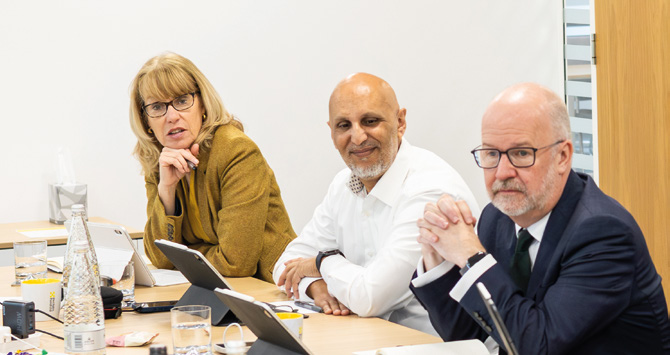
Year to 31/03/2026 Year to 31/03/2025
Staff average Total salary and allowances
6%
Bonus payments115%
Total salary and allowances
13%
Bonus payments13%
Highest paid Director Total salary and allowances
3%
Bonus payments129%
Total salary and allowances
5%
Bonus payments1(11%)

1 Bonus payments in the year reflect the average percentage change from the previous financial year in respect of the highest paid Director and the employees of the entity taken as a whole.

PENSIONS

A defined contribution plan is a pension arrangement where the employer pays fixed contributions into a separate fund. The costs for the defined contribution schemes are recognised as an expense in the Income Statement as incurred. For defined contribution plans, the employer has no further payment obligations once the contributions have been paid. The contributions are recognised as an employee benefit expense when they are due. RFL does not participate in the Civil Service Pension Scheme. The pension contribution rates for Executive Directors are aligned with those available to other employees at RFL.

STAFF TURNOVER

During the year, two members of permanent staff left the Company (2024/25: four).

Staff turnover, as defined in the Government Reporting Framework, requires disclosure for all changes to permanent staff and fixed-term contractors, which equated to six changes in staff in 2025/26 (2024/25: eight). Disclosing the percentage change to staff turnover is not considered to be beneficial given the small numbers of staff involved.

SERVICE AGREEMENTS AND EXIT PAYMENTS (AUDITED)

Our policy is to employ Executive Directors on standard contracts of employment with a six-month employer notice period; NEDs’ notice periods are three months. There were no exit payments made in 2025/26 or 2024/25.

REMUNERATION AND STAFF REPORT CONTINUED

MALE/FEMALE STAFF BREAKDOWN

The number of male and female staff at the end of each year was as follows:

31 March 2026 31 March 2025
Male Female Male Female
Non-Executive Directors 4 3 5 2
Executive Directors 1 1
Staff 4 16 3 15
Total 9 19 9 17

OFF-PAYROLL ENGAGEMENT

Off-payroll arrangements are engagements where personnel, either self-employed or acting through an intermediary company, are paid by invoice rather than via payroll. There were seven off-payroll engagements during 2025/26, all of which were earning £245 or more per day (2024/25: nine).

The tables below show off-payroll engagements by RFL at as 31 March 2026 where earnings exceeded £245 per day. There have been no Directors and/or senior officials with significant financial responsibility engaged under off-payroll engagement during 2025/26 and 2024/25.

All off-payroll appointments in place, earning at least £245 per day

At 31 March 2026

At 31 March 2025

That have existed for less than 1 year at reporting date 2 3
That have existed between 1 and 2 years at reporting date 1
That have existed between 2 and 3 years at reporting date 1
That have existed between 3 and 4 years at reporting date 1
That have existed for 4 or more years at reporting date
Total 3 5

All off-payroll appointments in place at any point during the period and earning at least £245 per day

12 months to 31 March 2026

12 months to 31 March 2025

Number where the off-payroll legislation does not apply
Number where off-payroll legislation does apply and assessed as within scope of IR35
Number where off-payroll legislation does apply and assessed as not within the scope of IR35 7 9
Number of appointments that were reassessed for consistency/assurance purposes during the year
Of which: Number of engagements that saw changes to the IR35 status following the assurance review
Total 7 9

CONSULTANTS

Total expenditure on external consultants during the year amounted to £0.8 million, remaining consistent with the previous year (2024/25: £1.0 million).

STAFF SICKNESS ABSENCE (ANNUAL WORKING DAYS LOST)

The average working days per employee lost to sickness absence during 2025/26 were 2.4 days (2024/25: 6.7 days). RFL remains confident that this does not present any concerns to the business, and notes that this statistic remains highly sensitive due to the size of the workforce.

MENTAL HEALTH AND WELLBEING

RFL has implemented a suite of individual and collective measures to ensure that employee welfare is robustly addressed: regular, informal, and interactive verbal and written communications supplement day-to-day team and line management interactions. Mental Health First Aiders have been trained within the business and RFL has recently secured ‘We Invest in Wellbeing’ certification.

GOVERNANCE

REMUNERATION AND STAFF REPORT CONTINUED

EQUAL OPPORTUNITIES

RFL is an equal opportunities employer. Policies are in place to ensure that no job applicant or member of staff receives less favourable treatment on grounds of age, disability, gender reassignment, marriage and civil partnership, pregnancy and maternity, race, religion or belief, sex and sexual orientation.

RFL recognises diversity and inclusion as necessities, both from a human and business perspective, and champions this policy across the organisation.

Diversity and inclusion approaches and targets feature in the RFL Sustainability ESG Framework. The FCA’s proposed diversity and inclusion targets set out in its recent consultation paper (CP23/20 Diversity and inclusion in the financial services sector – September 23) is considered best practice and is adopted by RFL and reflected in its risk appetite. The paper builds on the consultation paper CP 21/20 issued in July 2021 on diversity and inclusion targets on company boards and executive committees.

Within RFL’s Equal Opportunities, Diversity & Inclusion Policy, the Board has agreed diversity and inclusion targets which aim to:

1) have >40% of women on the Board; and

2) have at least one member of the Board from a Black, Asian or other minority ethnic background.

RFL is very conscious of the benefits of having diverse representation at Board level and considers this as part of succession planning. The Nomination Committee takes this into account for NED recruitment processes ensuring the external recruitment agency understands RFL’s values in this regard and that the application process is open, transparent, and inclusive. The Nomination Committee notes that the current gender balance of the Board (62% male, 38% female) has improved from last year and continues to be committed to promoting diversity in its broadest sense in future Board and leadership recruitment processes. When considering gender balance among the Non-Executive Directors, female representation on the Board stands at 43%, exceeds the FCA’s target.

RFL’s role as an Arm’s Length Body within the government provides access to a range of guidance around government-wide corporate legislation, codes of good practice and guidance. A key element of RFL’s values is its application of the Equalities Act 2010.

RFL is committed to valuing diversity and seeks to provide all employees with the opportunity for employment, career, and personal development on the basis of ability, qualifications, and suitability for the work as well as individuals’ potential to be developed whilst in role. RFL provides all reasonable assistance to employees who are or who become disabled, making reasonable adjustments wherever possible to provide continued employment.

HEALTH AND SAFETY

RFL recognises and accepts its responsibility as an employer to maintain, so far as is reasonably practical, the safety and health of its employees, and of other persons who may be affected by its activities.

DIRECTORS’ REPORT

To ensure the successful delivery of the Company’s strategy, RFL’s Board consists of Directors with a wide range of relevant skills, knowledge and experience.

The composition of the Board during the year is set out in the Corporate Governance Statement within the Governance section of this Annual Report and Accounts.

EMPLOYEES

The average number of employees during 2025/26 was 21 (2024/25: 18).

The Company is responsible for recruitment of its own staff. It welcomes diversity and actively promotes a policy and practice of equality of opportunity for all staff regardless of age, disability, gender reassignment, marriage and civil partnership, pregnancy and maternity, race, religion or belief, sex and sexual orientation.

FINANCIAL INSTRUMENTS

Financial risk management objectives can be found in the risk management note on page 88 in the notes to the Company Financial Statements.

ANNUAL REPORT AND ACCOUNTS

So far as the Directors are aware, there is no relevant audit information of which the Company’s auditors are unaware, and the Directors have taken all requisite steps to make themselves aware of any relevant audit information and to establish that the Company’s auditors are aware of that information.

A statement by the Directors as to their responsibilities for preparing the Annual Report and Accounts is included in the Statement of Directors’ Responsibilities in the subsequent section of this Annual Report and Accounts.

The Directors of the Company during the period 1 April 2025 to 8 July 2026 were:

NON-EXECUTIVE DIRECTORS

Judith Buttigieg

Rubaba Khan (from 1 September 2025)

Colin Ledlie

Donal Quaid

Saleh Saeed

Holger Vietten (until 31 August 2025)

Jenny Watson

Lawrence M. Weiss (Chair)

EXECUTIVE DIRECTOR

Adrian Smith (Chief Executive)

DISTRIBUTIONS

Under the Act, the only distributions the Company is permitted to make are to TNL CF. During the year £142.8 million of distributions were paid to TNLCF (2024/25: £143.4 million).

No dividend distributions were made to the parent, the Treasury Solicitor for the Affairs of His Majesty’s Treasury, in its capacity as nominee for HMVT, as this is not permitted by the Act.

GOING CONCERN AND VIABILITY STATEMENT

In accordance with the provisions within the Corporate Governance Code, the Directors have made a voluntary assessment of the viability of the Company. The Viability Statement, which supports the going concern basis, is included in the Risk Management section of the Corporate Governance Statement.

The Directors have considered the Company’s business activities together with its financial position and the factors likely to affect its future development and performance. In particular, the Directors have given careful consideration to the expected cash outflows compared to the available cash and liquid assets in both normal and stressed scenarios. This includes consideration of a realistic stress scenario, based on a series of events. The series of events comprise of an increase in societal awareness of RFL and dormancy, technological developments, and a willingness from Participants to apply the technology to dormant accounts retrospectively. This has been modelled to reflect a substantial fall in transfers into the scheme and an increase in reclaim rates.

Based on the above and noting the considerable cash headroom even under a reasonable stress event, the Directors believe that the Company will be able to meet liabilities as they fall due for a period of at least one year from the date of approval of the Financial Statements and therefore they consider it appropriate to prepare the Financial Statements on a going concern basis.

CHARITABLE AND POLITICAL DONATIONS

No charitable or political donations were made during the year (2024/25: £nil).

MATTERS COVERED IN THE STRATEGIC REPORT

All mandatory disclosures which the Directors consider to be of strategic importance are disclosed in the Strategic Report.

By order of the Board

ADRIAN SMITH OBE

Chief Executive

8 July 2026

Reclaim Fund Ltd

Registered number: 07344884

GOVERNANCE

STATEMENT OF DIRECTORS' AND ACCOUNTING OFFICER'S RESPONSIBILITIES

In respect of the Strategic Report, the Directors’ Report, the Directors’ Remuneration and Staff Report and the financial statements.

The Directors are responsible for preparing the Strategic Report, the Directors’ Report, the Directors’ Remuneration and Staff Report and the financial statements in accordance with applicable law and regulations.

Company law requires the Directors to prepare the Annual Report and Accounts for each financial period. Under that law, the Directors have elected to prepare the Annual Report and Accounts in accordance with UK Adopted International Accounting Standards (“IAS”).

Under company law, the Directors must not approve the Annual Report and Accounts unless they are satisfied that they give a true and fair view of the state of affairs of the Company and of the profit or loss of the Company for that year. The accounts are prepared on an accruals basis.

In preparing the Annual Report and Accounts, the Directors are required to:

  • select suitable accounting policies in accordance with IAS 8 Accounting Policies, Changes in Accounting Estimates and Errors and then apply them consistently;
  • make judgements and accounting estimates that are reasonable, relevant, and reliable;
  • present information, including accounting policies, in a manner that provides relevant, reliable, comparable, and understandable information;
  • provide additional disclosures when compliance with the specific requirements in International Financial Reporting Standards (‘IFRS’) is insufficient to enable users to understand the impact of particular transactions, other events and conditions on the Company’s financial position and financial performance;
  • in respect of the Annual Report and Accounts, state whether UK Adopted IAS have been followed, subject to any material departures disclosed and explained in the Annual Report and Accounts;
  • prepare the Annual Report and Accounts on the going concern basis unless it is appropriate to presume that the Company will not continue in business; and
  • prepare the information and disclosures required by the Acts.

The Directors are responsible for keeping adequate accounting records that are sufficient to show and explain the Company’s transactions and disclose with reasonable accuracy at any time the financial position of the Company, and enable them to ensure that the Financial Statements comply with the Companies Act 2006. They are also responsible for safeguarding the assets of the Company and hence for taking reasonable steps for the prevention and detection of fraud and other irregularities.

Each of the Directors confirms that, to the best of their knowledge and belief:

  • the Financial Statements, prepared in accordance with UK Adopted IAS in conformity with the requirements of the Companies Act 2006, give a true and fair view of the assets, liabilities, financial position and profit or loss of the Company;
  • the Directors’ Report contained in the Annual Report and Accounts includes a fair review of the development and performance of the business and the position of the Company, together with a description of the principal risks and uncertainties that they face; and
  • the Annual Report and Accounts, taken as a whole, are fair, balanced, and understandable, providing the information necessary for the Shareholder to assess the Company’s position and performance, business model, and strategy.

Under applicable United Kingdom law and regulations, the Directors are also responsible for preparing a Strategic Report and Directors’ Report that comply with that law and those regulations. The Directors are responsible for the maintenance and integrity of the corporate and financial information included on the Company’s website.

This report has been approved by the Board of Directors and is signed by the Chief Executive on behalf of the Board of Directors.

The Principal Accounting Officer of HMT has designated RFL’s Chief Executive as the Accounting Officer of RFL. The responsibilities of an Accounting Officer – including responsibility for the propriety and regularity of the public finances for which the Accounting Officer is answerable, for keeping proper records and for safeguarding RFL’s assets – are set out in the Managing Public Money document, published by HMT and updated from time to time.

STATEMENT OF DIRECTORS’ AND ACCOUNTING OFFICER’S RESPONSIBILITIES CONTINUED

In preparing the Financial Statements, the Accounting Officer is required to comply with the requirements of the Government Financial Reporting Manual where this requires additional disclosure that does not conflict with IFRS and the Companies Act, and in particular to:

  • observe the Accounts Direction issued by HMT, including the relevant accounting and disclosure requirements, and apply suitable accounting policies on a consistent basis;
  • make judgements and estimates on a reasonable basis;
  • state whether applicable accounting standards as set out in the Government Financial Reporting Manual have been followed, and disclose and explain any material departures in the Financial Statements;
  • prepare the Financial Statements on a going concern basis; and
  • take all the steps that ought to have been taken to make himself aware of any relevant audit information and to establish that RFL’s auditors are aware of that information.

As the Accounting Officer, I have taken all the steps that I ought to have taken to make myself aware of any relevant audit information and to establish that RFL’s auditors are aware of that information. So far as I am aware, there is no relevant audit information of which the auditors are unaware.

ADRIAN SMITH OBE Chief Executive, on behalf of the Board

8 July 2026

PARLIAMENTARY ACCOUNTABILITY AND AUDIT REPORT

The accounts of RFL are audited by the Comptroller and Auditor General under the terms of the Framework Document. The audit fee charged (exclusive of VAT) was £200k (2024/25: £195k). The auditors did not provide any non-audit services. The auditors have been provided with all relevant audit information necessary to complete their audit and the Accounting Officer has taken all necessary steps to ensure that the auditors are aware of any relevant information.

All expenditure was applied to the purpose intended by Parliament (audited).

RFL has not incurred any losses or special payments requiring disclosure, nor made any gifts during the reporting year to 31 March 2026 (31 March 2025: none) (audited).

In accordance with the terms of the Act, RFL has inherited the liability for all dormant balances transferred from Participants and as such discloses remote contingent liabilities totalling £1,573.4 million (2024/25: £1,222.8 million) (audited). This balance represents the remaining exposure that RFL may be required to settle above and beyond the amounts already set aside within the provision for reclaims and capital reserves.

ADRIAN SMITH OBE

Chief Executive

8 July 2026

INDEPENDENT AUDITOR’S REPORT

TO THE MEMBERS OF RECLAIM FUND LTD AND THE HOUSES OF PARLIAMENT

OPINION ON FINANCIAL STATEMENTS

I have audited the Financial Statements of Reclaim Fund Ltd for the year ended 31 March 2026 which comprise Reclaim Fund Ltd’s:

  • Statement of Financial Position as at 31 March 2026;
  • Statement of Comprehensive Income, Statement of Cash Flows and Statement of Changes in Equity for the year then ended; and
  • the related notes including the significant accounting policies.

The financial reporting framework that has been applied in the preparation of the Financial Statements is applicable law and the UK adopted International Accounting Standards.

In my opinion the Financial Statements:

  • give a true and fair view of the state of Reclaim Fund Ltd’s affairs as at 31 March 2026 and of its retained loss for the financial year then ended;
  • have been properly prepared in accordance with the UK adopted International Accounting Standards; and
  • have been prepared in accordance with the requirements of the Companies Act 2006.

OPINION ON REGULARITY

In my opinion, in all material respects the income and expenditure recorded in the Financial Statements have been applied to the purposes intended by Parliament and the financial transactions recorded in the Financial Statements conform to the authorities which govern them.

BASIS FOR OPINIONS

I conducted my audit in accordance with International Standards on Auditing (UK) (ISAs (UK)), applicable law and Practice Note 10 ‘Audit of Financial Statements and Regularity of Public Sector Bodies in the United Kingdom (2024)’ My responsibilities under those standards are further described in the Auditor’s responsibilities for the audit of the Financial Statements section of my report.

Those standards require me and my staff to comply with the Financial Reporting Council’s Revised Ethical Standard 2024. I am independent of Reclaim Fund Ltd in accordance with the ethical requirements that are relevant to my audit of the Financial Statements in the UK. My staff and I have fulfilled our other ethical responsibilities in accordance with these requirements.

I believe that the audit evidence I have obtained is sufficient and appropriate to provide a basis for my opinion.

The framework of authorities described in the table below has been considered in the context of my opinion on regularity.

Framework of Authorities

Authorising legislation Companies Act 2006
Parliamentary authorities Dormant Bank and Building Society Accounts Act 2008
Dormant Assets Act 2022¹
HM Treasury and related authorities Managing Public Money
Framework document between HM Treasury and Reclaim Fund Ltd dated 16 April 2021
Regulatory Authorities Financial Conduct Authority regulation

1 Collectively, Dormant Assets Acts 2008 to 2022.

GOVERNANCE

INDEPENDENT AUDITOR’S REPORT CONTINUED

CONCLUSIONS RELATING TO GOING CONCERN

In auditing the Financial Statements, I have concluded that Reclaim Fund Ltd’s use of the going concern basis of accounting in the preparation of the Financial Statements is appropriate.

My evaluation of the director’s assessment of the entity’s ability to continue to adopt the going concern basis of accounting included a review of the management’s liquidity and capital forecasts which evaluate known risks and a range of stress scenarios.

Based on the work I have performed, I have not identified any material uncertainties relating to events or conditions that, individually or collectively, may cast significant doubt on Reclaim Fund Ltd’s ability to continue as a going concern for a period of at least twelve months from when the Financial Statements are authorised for issue.

In relation to the entities reporting on how they have applied the UK Corporate Governance Code, I have nothing material to add or draw attention to in relation to the directors’ statement in the Financial Statements about whether the directors considered it appropriate to adopt the going concern basis of accounting.

My responsibilities and the responsibilities of the directors with respect to going concern are described in the relevant sections of this report.

OVERVIEW OF MY AUDIT APPROACH

KEY AUDIT MATTERS

Key audit matters are those matters that, in my professional judgement, were of most significance in the audit of the Financial Statements of the current period and include the most significant assessed risks of material misstatement (whether or not due to fraud) identified by the auditor, including those which had the greatest effect on: the overall audit strategy; the allocation of resources in the audit; and directing the efforts of the engagement team.

These matters were addressed in the context of the audit of the Financial Statements as a whole, and in forming my opinion thereon, I do not provide a separate opinion on these matters.

This is not a complete list of all risks identified though the course of my audit but only those areas that had the greatest effect on my overall audit strategy, allocation of resources and direction of effort. I have not, for example, included information relating to the work I have performed around the presumed risk of fraud through management override of controls, an area where my work has not identified any matters to report. I also recognised a significant risk relating to Reclaim Fund Ltd’s implementation of a new Customer Relationship Management (CRM) system on 1 August 2025. I did not consider this a key audit matter as the work required to obtain assurance that it had been implemented effectively was not complex or judgmental, nor did it take significant resource to complete.

The key audit matters were discussed with the Audit and Risk Committee; their report on matters that they considered to be significant to the Financial Statements is set out on pages 40 to 43.

In this year’s report the following changes to the risks identified have been made compared to my prior year report:

• In the year to 31 March 2026, Reclaim Fund Ltd recognised additions of £183.3 million (31 March 2025: £241.1 million) and derecognitions of £169.6 million (31 March 2025: £103.7 million) in relation to investment securities. In the prior year, I identified a significant risk due to the level of activity. However, investment activity continues to be limited to high credit quality, non-complex instruments, executed through established and standardised processes. Securities are held to maturity and derecognised in accordance with contractual terms, without the need for management judgement or discretionary decisions. Accordingly, I have not identified a significant risk in relation to investment securities in the current year.

INDEPENDENT AUDITOR’S REPORT CONTINUED

KEY AUDIT MATTER 1

Description of risk

How the scope of my audit responded to the risk

Description of risk

Dormant account balances are transferred to Reclaim Fund Ltd from UK financial institutions under the Dormant Assets Act 2008 to 2022. Under the requirements of the Acts, the obligation to repay dormant account holders who subsequently reclaim their money is transferred to Reclaim Fund Ltd. As at 31 March 2026, Reclaim Fund Ltd recognised a provision of £207.1 million (31 March 2025: £182.1 million) in respect of dormant bank and building society accounts.

I have not recognised a significant risk in relation to the provisions in respect of the Insurance, Pensions, and Investment and Wealth Management sectors as these Schemes are not material and therefore do not pose a significant risk of material misstatement for my audit.

The provision for reclaims of all dormant account balances is the main source of estimation uncertainty in the Financial Statements. For the provision for reclaims of dormant bank and building society asset balances, I identified significant risks of material misstatement around the method, model and data used to calculate the provision, assumptions made by management and the completeness and accuracy of disclosures made around estimation uncertainty. In the current year, data risk increased following the mid-year implementation of a new CRM system, introducing additional exposure to data integrity risks arising from system migration. Accordingly, I identified data as a significant risk in relation to the estimation of the dormant bank and building society provision

As explained in note 1 to the Financial Statements, management has measured the dormant bank and building society account provision using an actuarial model developed by experts which forecasts future cash flows based on historic experience of reclaims observed (the “base model”). Reclaim Fund Ltd adds an additional margin to reflect that historic reclaims have been in a benign environment and may not be indicative of future expectations. The assumptions made in measuring the provision, particularly in relation to the additional margin are an area of significant management judgement. As disclosed in note 1 to the Financial Statements, Reclaim Fund Ltd considers the measurement of the provision to be inherently complex with significant estimation uncertainty relating to the quantum of reclaims expected and the time period over which reclaims will continue.

How the scope of my audit responded to the risk

I tested the design and implementation of key controls including the controls and governance in place over the best estimate model and additional margin for the dormant bank and building societies sector provision, and over assumptions made in calculating the estimate.

I also performed the following procedures to address the significant risks of material misstatement:

• I assessed the approach to measuring the provision against the requirements of IAS 37 to determine a best estimate of the expenditure required to settle the obligations.

• I engaged an independent auditor’s expert to assess the methodological approach taken by management’s experts to determine the best estimate of the provisions.

• I assessed the actuarial experts used by management under ISA 500 Audit Evidence to enable me to use their work as audit evidence.

• I assessed the application of the methods used to calculate the base model by using my auditor’s expert to develop a challenger model to estimate the model output at the reporting date.

• I tested the application of methods used to calculate the additional margin by performing management’s calculations.

• I tested the key data inputs underpinning the calculation of the best estimate provision by assessing their completeness and accuracy through testing a sample of transfers of dormant account balances and reclaims, reconciling these to the Financial Statements and the model input data, and agreeing that historical data has been correctly brought forward.

• I evaluated the overall provision calculated by management against a range developed by my auditor’s expert.

• I assessed the completeness and appropriateness of significant assumptions in both the base model and additional margin using my auditor’s expert, including the rationale for key judgements and the reasonableness of the assumptions made.

• I evaluated management’s assessment of estimation uncertainty and related disclosures.

Key observations

The outcomes of the procedures I performed in response to the risk were satisfactory. I noted no material issues arising from my work.

GOVERNANCE

INDEPENDENT AUDITOR’S REPORT CONTINUED

APPLICATION OF MATERIALITY

Materiality

I applied the concept of materiality in both planning and performing my audit, and in evaluating the effect of misstatements on my audit and on the Financial Statements. This approach recognises that Financial Statements are rarely absolutely correct, and that an audit is designed to provide reasonable, rather than absolute, assurance that the Financial Statements are free from material misstatement or irregularity. A matter is material if its omission or misstatement would, in the judgement of the auditor, reasonably influence the decisions of users of the Financial Statements.

Based on my professional judgement, I determined overall materiality for Reclaim Fund Ltd’s Financial Statements as a whole as follows:

Reclaim Fund Ltd

Materiality £10,000,000
Basis for determining materiality 1% of total assets of £1,028.9 million (31 March 2025: £906.2 million)
Rationale for the benchmark applied I have based materiality on total assets on the basis that this represents the assets received from dormant account holders and under the control of Reclaim Fund Ltd and therefore available to repay reclaimers from dormant account holders or for making future distributions subject to the company continuing to hold sufficient regulatory capital. I assess this to be the primary interest of the key users of the accounts including Scheme Participants, dormant account holders and The National Lottery Community Fund.

Performance Materiality

I set performance materiality at a level lower than materiality to reduce the probability that, in aggregate, uncorrected and undetected misstatements exceed the materiality for the Financial Statements as a whole. Performance materiality was set at 75% of materiality for the 2025-26 audit (2024-25: 75%). In determining performance materiality, I considered the governance and internal control system in place at Reclaim Fund Ltd. While the account contains significant judgements and estimations, I do not consider that these warrant a reduced level of performance materiality. I have also considered the uncorrected misstatements identified in the previous period.

Other Materiality Considerations

Apart from matters that are material by value (quantitative materiality), there are certain matters that are material by their very nature and would influence the decisions of users if not corrected. Such an example is any errors reported in the Related Parties note in the Financial Statements. Assessment of such matters needs to have regard to the nature of the misstatement and the applicable legal and reporting framework, as well as the size of the misstatement.

I applied the same concept of materiality to my audit of regularity. In planning and performing audit work to support my opinion on regularity and in evaluating the impact of any irregular transactions, I considered both quantitative and qualitative aspects that would reasonably influence the decisions of users of the Financial Statements.

Error Reporting Threshold

I agreed with the Audit and Risk Committee that I would report to it all uncorrected misstatements identified through my audit in excess of £150,000, as well as differences below this threshold that in my view warranted reporting on qualitative grounds. I also report to the Audit and Risk Committee on disclosure matters that I identified when assessing the overall presentation of the Financial Statements.

The net impact of unadjusted differences on the Statement of Comprehensive Income and Statement of Financial Position was £nil (2024-25 £nil).

AUDIT SCOPE

The scope of my audit was determined by obtaining an understanding of Reclaim Fund Ltd and its environment, including the entity wide controls, and assessing the risks of material misstatement. This included consideration of the risks of non-compliance with the entity’s framework of authorities and the audit procedures required to address those risks.

INDEPENDENT AUDITOR’S REPORT CONTINUED

OTHER INFORMATION

The other information comprises the information included in the Annual Report, but does not include the Financial Statements and my auditor’s report thereon. The directors are responsible for the other information.

My opinion on the Financial Statements does not cover the other information and, except to the extent otherwise explicitly stated in my report, I do not express any form of assurance conclusion thereon.

My responsibility is to read the other information and, in doing so, consider whether the other information is materially inconsistent with the Financial Statements or my knowledge obtained in the audit, or otherwise appears to be materially misstated.

If I identify such material inconsistencies or apparent material misstatements, I am required to determine whether this gives rise to a material misstatement in the Financial Statements themselves. If, based on the work I have performed, I conclude that there is a material misstatement of this other information, I am required to report that fact.

I have nothing to report in this regard.

OPINION ON OTHER MATTERS PRESCRIBED BY THE COMPANIES ACT 2006

In my opinion, based on the work undertaken in the course of the audit:

  • the information given in the Strategic Report and the Directors’ Report for the financial year for which the Financial Statements are prepared is consistent with the Financial Statements;
  • the Strategic Report and the Directors’ Report have been prepared in accordance with applicable legal requirements;
  • the information about internal control and risk management systems in relation to financial reporting processes, and about share capital structures, in compliance with rules 7.2.5 and 7.2.6 in the Disclosure Rules and Transparency Rules sourcebook made by the Financial Conduct Authority (the FCA Rules), is consistent with the Financial Statements and has been prepared in accordance with applicable legal requirements; and
  • Information about Reclaim Fund Ltd corporate governance code and practices and about its administrative, management and supervisory bodies and their committees complies with rules 7.2.2, 7.2.3 and 7.2.7 of the FCA Rules.

OTHER MATTERS

In my opinion:

  • the part of the Remuneration and Staff Report to be audited has been properly prepared in accordance with HM Treasury’s Government Financial Reporting Manual; and
  • the parts of the Annual Report subject to audit have been properly prepared in accordance with HM Treasury’s Government Financial Reporting Manual.

MATTERS ON WHICH I REPORT BY EXCEPTION

In the light of the knowledge and understanding of Reclaim Fund Ltd and its environment obtained in the course of the audit, I have not identified material misstatements:

  • in the Strategic Report or the Directors’ Report; or
  • the information about internal control and risk management systems in relation to financial reporting processes and about share capital structures, given in compliance with rules 7.2.5 and 7.2.6 of the FCA rules.

I have nothing to report in respect of the following matters in relation to which the Companies Act 2006 requires me to report to you if, in my opinion:

  • adequate accounting records have not been kept or returns adequate for my audit have not been received from branches not visited by my staff; or
  • I have not received all of the information and explanations I require for my audit; or
  • the Financial Statements and the parts of the Remuneration and Staff Report to be audited are not in agreement with the accounting records and returns; or
  • certain disclosures of director’s remuneration specified by law are not made; or
  • the Governance Statement does not properly disclose a departure from the requirements of the UK Corporate Governance Code.

GOVERNANCE

INDEPENDENT AUDITOR’S REPORT CONTINUED

CORPORATE GOVERNANCE STATEMENT

The Listing Rules require me to review the Directors’ statement in relation to going concern, longer-term viability and that part of the Corporate Governance Statement relating to Reclaim Fund Ltd’s compliance with the provisions of the UK Corporate Governance Code specified for my review.

Based on the work undertaken as part of my audit, I have concluded that each of the following elements of the Corporate Governance Statement is materially consistent with the Financial Statements or my knowledge obtained during the audit:

• Directors’ statement with regards the appropriateness of adopting the going concern basis of accounting and any material uncertainties identified set out on page 55;

• Directors’ explanation as to its assessment of the entity’s prospects, the period this assessment covers and why the period is appropriate set out on page 48;

• Directors’ statement on fair, balanced and understandable set out on pages 56 and 57;

• Board’s confirmation that it has carried out a robust assessment of the emerging and principal risks set out on pages 31 to 35;

• the section of the annual report that describes the review of effectiveness of risk management and internal control systems set out on page 32; and

• the section describing the work of the audit and risk committee set out on page 43.

RESPONSIBILITIES OF THE DIRECTORS FOR THE FINANCIAL STATEMENTS

As explained more fully in the Statement of Directors’ and Accounting Officer’s Responsibilities, the directors are responsible for:

• maintaining proper accounting records;

• providing the C&AG with access to all information of which management is aware that is relevant to the preparation of the Financial Statements such as records, documentation and other matters;

• providing the C&AG with additional information and explanations needed for his audit;

• providing the C&AG with unrestricted access to persons within Reclaim Fund Ltd from whom the auditor determines it necessary to obtain audit evidence.

• preparing Financial Statements, which give a true and fair view, in accordance with the Companies Act 2006 and the information and disclosures required by the Dormant Assets Acts 2008 to 2022;

• ensuring such internal controls are in place as deemed necessary to enable the preparation of Financial Statement to be free from material misstatement, whether due to fraud or error;

• preparing the Annual Report in accordance with the Companies Act 2006;

• preparing the Remuneration and Staff Report, which is included in the Annual Report, in accordance with the Government Financial Reporting Manual; and

• assessing Reclaim Fund Ltd’s ability to continue as a going concern, disclosing, as applicable, matters related to going concern and using the going concern basis of accounting unless the directors either intends to liquidate the entity or to cease operations, or has no realistic alternative but to do so.

INDEPENDENT AUDITOR’S REPORT CONTINUED

AUDITOR’S RESPONSIBILITIES FOR THE AUDIT OF THE FINANCIAL STATEMENTS

My responsibility is to audit and report on the Financial Statements in accordance with the applicable law and International Standards on Auditing (UK) (ISAs (UK)).

My objectives are to obtain reasonable assurance about whether the Financial Statements as a whole are free from material misstatement, whether due to fraud or error, and to issue a report that includes my opinion. Reasonable assurance is a high level of assurance but is not a guarantee that an audit conducted in accordance with ISAs (UK) will always detect a material misstatement when it exists. Misstatements can arise from fraud or error and are considered material if, individually or in the aggregate, they could reasonably be expected to influence the economic decisions of users taken on the basis of these Financial Statements.

EXTENT TO WHICH THE AUDIT WAS CONSIDERED CAPABLE OF DETECTING NON-COMPLIANCE WITH LAWS AND REGULATIONS INCLUDING FRAUD

I design procedures in line with my responsibilities, outlined above, to detect material misstatements in respect of non-compliance with laws and regulations, including fraud. The extent to which my procedures are capable of detecting non-compliance with laws and regulations, including fraud is detailed below.

Identifying and assessing potential risks related to non-compliance with laws and regulations, including fraud

In identifying and assessing risks of material misstatement in respect of non-compliance with laws and regulations, including fraud, I:

  • considered the nature of the sector, control environment and operational performance including the design of Reclaim Fund Ltd’s accounting policies and performance incentives;
  • inquired of management, head of Reclaim Fund Ltd’s internal audit service and those charged with governance, including obtaining and reviewing supporting documentation relating to Reclaim Fund Ltd’s policies and procedures on:
    • identifying, evaluating and complying with laws and regulations;
    • detecting and responding to the risks of fraud; and
    • the internal controls established to mitigate risks related to fraud or non-compliance with laws and regulations including Reclaim Fund Ltd’s controls relating to Reclaim Fund Ltd’s compliance with the Companies Act 2006, Dormant Assets Acts 2008 to 2022, regulatory requirements imposed by the Financial Conduct Authority and Managing Public Money.
  • inquired of management, head of Reclaim Fund Ltd’s internal audit service and those charged with governance whether:
    • they were aware of any instances of non-compliance with laws and regulations; and
    • they had knowledge of any actual, suspected, or alleged fraud;
  • discussed with the engagement team and the relevant external specialists, including auditor’s experts, regarding how and where fraud might occur in the Financial Statements and any potential indicators of fraud.

As a result of these procedures, I considered the opportunities and incentives that may exist within Reclaim Fund Ltd for fraud and identified the greatest potential for fraud in the following areas: revenue recognition, posting of unusual journaIs, complex transactions, bias in management estimates and in particular the provisions for reclaims of dormant account balances. In common with all audits under ISAs (UK), I am required to perform specific procedures to respond to the risk of management override.

I obtained an understanding of Reclaim Fund Ltd’s framework of authority and other legal and regulatory frameworks in which Reclaim Fund Ltd operates. I focused on those laws and regulations that had a direct effect on material amounts and disclosures in the Financial Statements or that had a fundamental effect on the operations of Reclaim Fund Ltd. The key laws and regulations I considered in this context included Companies Act 2006, Managing Public Money, Dormant Assets Acts 2008 to 2022, employment law, tax legislation and regulatory requirements imposed by the Financial Conduct Authority.

GOVERNANCE

INDEPENDENT AUDITOR’S REPORT CONTINUED

AUDIT RESPONSE TO IDENTIFIED RISK

To respond to the identified risks resulting from the above procedures:

  • I reviewed the Financial Statement disclosures and testing to supporting documentation to assess compliance with provisions of relevant laws and regulations described above as having direct effect on the Financial Statements;
  • I enquired of management, the Audit and Risk Committee and legal counsel concerning actual and potential litigation and claims;
  • I reviewed minutes of meetings of those charged with governance and the Board and internal audit reports;
  • I addressed the risk of fraud through management override of controls by testing the appropriateness of journal entries and other adjustments; assessing whether the judgements made on estimates are indicative of a potential bias; and evaluating the business rationale of any significant transactions that are unusual or outside the normal course of business; and
  • I reviewed correspondence between Reclaim Fund Ltd and the Financial Conduct Authority.

I communicated relevant identified laws and regulations and potential risks of fraud to all engagement team members including external specialists and remained alert to any indications of fraud or non-compliance with laws and regulations throughout the audit.

A further description of my responsibilities for the audit of the Financial Statements is located on the Financial Reporting Council’s website at: www.frc.org.uk/auditorstresponsibilities. This description forms part of my report.

OTHER AUDITOR’S RESPONSIBILITIES

I am required to obtain sufficient appropriate audit evidence to give reasonable assurance that the expenditure and income recorded in the Financial Statements have been applied to the purposes intended by Parliament and the financial transactions recorded in the Financial Statements conform to the authorities which govern them.

I communicate with those charged with governance regarding, among other matters, the planned scope and timing of the audit and significant audit findings, including any significant deficiencies in internal control I identify during my audit.

STEPHEN YOUNG

(Senior Statutory Auditor)

9 July 2026

For and on behalf of the

Comptroller and Auditor General (Statutory Auditor)

National Audit Office

157-197 Buckingham Palace Road

Victoria

London

SW1W 9SP

FINANCIAL STATEMENTS

CONTENTS

FINANCIAL STATEMENTS

STATEMENT OF COMPREHENSIVE INCOME

FOR THE YEAR ENDED 31 MARCH 2026

Statement of comprehensive income for the year ended 31 March 2026
Notes 2025/26 £’000 2024/25 £’000
Amounts received in respect of dormant accounts 4 272,495 173,004
Interest income 5 37,994 36,756
Interest expense 5 (10) (10)
Net income 310,479 209,750
Operating expenses 3 (5,780) (5,067)
Set-up costs for expansion of Dormant Assets Scheme 3 (1,282) (1,238)
Provision expense for reclaims of dormant account balances 9 (50,353) (39,152)
Operating result before distributions 253,064 164,293
Provision for future distributions to TNLCF 10 (370,328) (142,752)
(Loss)/surplus before taxation (117,264) 21,541
Taxation charge 6 (7,730) (7,470)
Retained (loss)/surplus for the financial year (124,994) 14,071
Other comprehensive income for the year
Total comprehensive (loss)/income for the financial year (124,994) 14,071

Total comprehensive income is attributable to the equity holders of the Company. The Act prohibits the capital reserve being distributed to the parent company.

The notes on pages 72 to 89 form part of the Financial Statements.

STATEMENT OF FINANCIAL POSITION

AS AT 31 MARCH 2026

Assets

Notes 31 March 2026
£’000
31 March 2025
£’000
Cash and cash equivalents 8 545,924 438,478
Investment securities 7 482,437 467,320
Trade and other receivables 276 151
Intangible assets 16 22
Plant and equipment 111 109
Right-of-use assets 136 145
Total assets 1,028,900 906,225

Liabilities

Notes 31 March 2026
£’000
31 March 2025
£’000
Trade and other payables 1,444 2,962
Deferred tax liability 6 15 10
Lease liabilities 173 171
Provision for future distributions 10 370,328 142,752
Provision for reclaims of dormant account balances 9 211,709 186,653
Current income tax liability 129 3,581
Total liabilities 583,798 336,129

Capital and reserves

Notes 31 March 2026
£’000
31 March 2025
£’000
Share capital 12
Capital reserve 12 445,102 570,096
Total equity 445,102 570,096

Total liabilities and equity

31 March 2026
£’000
31 March 2025
£’000
1,028,900 906,225

The notes on pages 72 to 89 form part of the Financial Statements.

Approved by the Board of Directors on 8 July 2026 and signed on its behalf by:

ADRIAN SMITH OBE

Chief Executive

FINANCIAL STATEMENTS

STATEMENT OF CASH FLOWS

FOR THE YEAR ENDED 31 MARCH 2026

Notes 2025/26
2024/25

(Loss)/income before tax

(117,264) 21,541

Adjustments:

Amortisation of intangibles 14 12
Depreciation of plant and equipment 56 60
Depreciation of right-of-use asset 38 31
Increase in trade and other receivables 126 88
(Decrease)/increase in accrued expenses (1,515) 1,966
Change in provision for reclaims of dormant account balances 49,758 38,689
Additional provision for future distributions 370,328 142,752
Interest receivable (37,994) (36,756)
Interest expense on Participant reclaims 595 464
Interest expense on leases 10 10
Movement on expected credit loss (6) (2)

Subtotal of adjustments

264,146 168,855

Cash flows from operating activities

Payments made in respect of Participant reclaims (24,702) (25,976)
Interest paid on Participant reclaims (595) (464)
Distribution payments (142,752) (143,407)
Corporation tax paid (11,179) (6,710)

Net cash flows from operating activities

84,918 (7,702)

Cash flows from investing activities

Purchase of investment securities (183,290) (241,107)
Proceeds from maturity of investment securities 165,580 96,865
Proceeds from early call of investment securities 4,000 6,825
Interest received 36,353 37,814
Purchase of plant and equipment (59) (96)
Purchase of intangibles (8)
Payments of lease liability (48) (43)

Net cash flows from investing activities

22,528 (99,742)

Net increase/(decrease) in cash and cash equivalents

107,446 (107,444)
Cash and cash equivalents at the beginning of the financial year 438,478 545,922

Cash and cash equivalents at the end of the financial year

545,924 438,478

The notes on pages 72 to 89 form part of the Financial Statements.

STATEMENT OF CHANGES IN EQUITY

FOR THE YEAR ENDED 31 MARCH 2026

Notes Share capital £’000 Capital reserve £’000 Total £’000
2025/26
Balance at 1 April 2025 570,096 570,096
Total comprehensive loss for the financial year (124,994) (124,994)
Balance at 31 March 2026 12 445,102 445,102
2024/25
Balance at 1 April 2024 556,025 556,025
Total comprehensive income for the financial year 14,071 14,071
Balance at 31 March 2025 12 570,096 570,096

The notes on pages 72 to 89 form part of the Financial Statements.

The Act prohibits the capital reserve being distributed to the Parent Company.

FINANCIAL STATEMENTS

NOTES TO THE COMPANY FINANCIAL STATEMENTS

FOR THE YEAR ENDED 31 MARCH 2026

1. SIGNIFICANT ACCOUNTING POLICIES

BASIS OF PREPARATION

Reclaim Fund Ltd is a limited liability company, incorporated and domiciled in the United Kingdom and registered in England and Wales.

The Financial Statements have been prepared under the historic cost convention. The Company’s Financial Statements are prepared in accordance with UK Adopted International Accounting Standards, in conformity with the requirements of the Companies Act 2006 and, as appropriate, in relation to the Financial Statements and selected disclosures within the Annual Report only, the Government Financial Reporting Manual and other guidance issued by HM Treasury where the disclosure requirements of these go beyond the Companies Act 2006. All amounts presented are stated in thousands of GBP (£’000), unless otherwise stated. The Statement of Financial Position is ordered according to liquidity and gives prominence to principal balances.

STANDARDS AND ACCOUNTING POLICIES ADOPTED BY THE COMPANY

The accounting policies applied in preparing these Financial Statements are consistent with those described in the 2024/25 Annual Report and Accounts.

STANDARDS AND INTERPRETATIONS NOT YET EFFECTIVE

IFRS 18 PRESENTATION AND DISCLOSURE IN FINANCIAL STATEMENTS

IFRS 18 was issued in April 2024 and applies to annual reporting periods beginning on or after 1 January 2027. RFL does not intend to early-adopt IFRS 18.

IFRS 18 sets out general and specific requirements for the presentation and disclosure of information in general purpose financial statements. The objective of IFRS 18 is to improve comparability of financial performance between organisations applying IFRS. Once effective, IFRS 18 will replace IAS 1 Presentation of Financial Statements. The impact of adopting this standard is still being assessed.

IFRS 19 SUBSIDIARIES WITHOUT PUBLIC ACCOUNTABILITY: DISCLOSURES

IFRS 19 was issued in May 2024 and applies to annual reporting periods beginning on or after 1 January 2027.

IFRS 19 sets out the disclosure requirements an entity is permitted to apply instead of the disclosure requirements in other IFRS Accounting Standards. An entity electing to apply IFRS 19 can align its policies with its parent company for group reporting purposes.

As RFL does not have any subsidiary entities, we do not believe this will have any material impact on our disclosures.

There are no other IFRS or IFRIC interpretations not yet effective that would be expected to have a material impact on RFL.

EXISTING POLICIES

USE OF ESTIMATES AND JUDGEMENTS

The preparation of the Annual Report and Accounts requires the Directors to make judgements, estimates and assumptions that affect the application of accounting policies and the reported assets, liabilities, income and expenses. Actual results may differ from these estimates.

Estimates and underlying assumptions are reviewed on an ongoing basis. Revisions to accounting estimates are recognised in the year in which the estimate is revised and in any future years affected.

Significant areas of estimation uncertainty that have the most effect on the amounts recognised in the Annual Report and Accounts relate to the provisions for reclaims of dormant asset balances of £211.7 million (2024/25: £186.7 million). The provision for future distributions of £370.3 million (2024/25: £142.8 million) is also considered to be a key accounting judgement given the Board has total discretion over the amount of distributions. These are discussed below.

PROVISION FOR RECLAIMS OF DORMANT ASSET BALANCES

Upon transfer of dormant account assets from UK financial institutions to the Company, the obligation to repay dormant asset holders who subsequently reclaim their money is also transferred to the Company. The Directors regard the provision as a key accounting estimate.

The Company therefore records a reclaim provision that is calculated as the best estimate which represents expected future cash flows required to settle future repayments of dormant asset balances.

NOTES TO THE COMPANY FINANCIAL STATEMENTS CONTINUED

FOR THE YEAR ENDED 31 MARCH 2026

1. SIGNIFICANT ACCOUNTING POLICIES CONTINUED

BEST ESTIMATE METHODOLOGY

The methodology for calculating the best estimate provision utilises the quantity of historical reclaim information available for each sector. For Bank and Building Society assets, RFL holds 14 years’ worth of historical reclaim information, in significant contrast to the newer asset classes in the Insurance, Pensions, and Investment and Wealth Management sectors where only a small number of reclaims have been paid. The table below shows the split per sector.

31 March 2026 £’000 31 March 2025 £’000
Best Estimate Reclaim provision
Bank and Building Societies sector 206,225 181,836
Main Scheme 88,850
Alternative Scheme 206,225 181,836
Bank and Building Societies sector total 207,110 182,130
Insurance sector 4,511 4,419
Pensions sector 49 104
Investment and Wealth Management sector 39
At the end of the year 211,709 186,653

The approach to the sectors is detailed below:

BEST ESTIMATE FOR BANK AND BUILDING SOCIETIES SECTOR

The best estimate contains two components: a future reclaim projection derived by fitting a generalised linear model (‘GLM’) to the historical reclaims incurred, and an additional margin to project future expected reclaims on an annual basis into the future, compared to historical levels. The GLM is used to project future expected reclaims based on past reclaim experience, which are then discounted to give a present value of future reclaims. Given there is limited historical data, which may cover a relatively benign period, and recognising the potential for future events not captured in the data to impact future reclaim rates, there remains uncertainty in the projections. The additional margin is therefore added to allow for an expected increase in future reclaims compared to historic levels, such as through advancements in technology that make reunification of dormant asset easier.

The additional margin is set by expert judgement, obtained through a workshop that brings together RFL Management and industry experts with varying backgrounds and experiences to consider recent experience and scenarios which might lead to a increase in reclaim rates.

During last year’s workshop, one realistic scenario emerged based on a series of events. The additional margin was then calculated by considering the likelihood and average impact of the one realistic scenario on ultimate reclaim rates. The series of events comprised of an increase in societal awareness of RFL and dormancy, technological developments and a willingness from Participants, through choice and/or reputational or regulatory pressure to apply the technology to dormant accounts retrospectively. Management reviewed the output from the workshop, which included both the voting results and the main points of discussion, and set the margin at 4% of total initial balances.

At this year’s workshop no new events were identified, but the likelihood and expected impact of the one realistic scenario were considered to be lower, due to a reduction in perceived risk related to artificial intelligence, along with acknowledgement that some risks (such as regulatory pressure) naturally diminish as more time passes. Management have considered the discussion at the workshop and the voting results and have set the additional margin in line with the voting results, which was 3% of total initial balances. Management concluded that a reduction of 1 percentage point in the additional margin is reasonable, based on workshop discussions and noting that the previous year’s voting results of 3.6% was rounded up to give a margin of 4%. A gradual downward trend in the provision over time is reasonable given the greater insight into the liabilities afforded by having more data, and an increased understanding of the risks faced by RFL as the business matures.

To the extent that actual reclaims are different from those provided for, changes in the provision are reflected in the Income Statement.

The calculation of the provision for future repayments of dormant asset balances is inherently complex, with significant amounts of uncertainty in the quantum of reclaims expected and the time period for which reclaims will continue.

In addition, Management continues to monitor actual reclaim rates to assess whether the provisioning methodology remains appropriate.

FINANCIAL STATEMENTS

NOTES TO THE COMPANY FINANCIAL STATEMENTS CONTINUED

FOR THE YEAR ENDED 31 MARCH 2026

1. SIGNIFICANT ACCOUNTING POLICIES CONTINUED

ASSUMPTIONS USED IN THE BEST ESTIMATE

The key assumptions within the best estimate at 31 March 2026 are as follows:

1. Future reclaim rates will continue to follow an exponential decay curve fitted to past reclaim experience, and will vary by account size, originating bank or building society, category of account (relating to availability of account level data, defined within the Transfer and Agency Agreement), and whether the transfer contains accounts that have just reached the required 15 years of dormancy when transferred to RFL or have been dormant for longer.

2. Individual large amounts over £1 million transferred to RFL are deemed to have a higher likelihood of reclaim (50%), as to date there appears to be a relationship between account size and reclaim proportion; and

3. The discount rate applied uses government bond yields at the balance sheet date that reflects market assessments of the time value of money. A discount rate of 4.8% was applied at 31 March 2026 (31 March 2025: 4.6%).

As explained in the accounting policy note above, there is an additional margin of 3% (2024/25: 4%) to allow for a potential expected increase in future reclaims compared to historical levels. The additional margin is lower than last year, which reflects experts’ views that the likelihood and expected impact of a realistic future scenario on reclaim rates have decreased over the year.

With the exception of balances greater than £1 million as described above, no dormant balance transfers are excluded from the source data input into the GLM, thereby ensuring all data is modelled irrespective of reclaim behaviour within the analysis. Transfers with either very high or very low reclaim rates are included to provide an accurate representation of the whole portfolio.

SENSITIVITY ANALYSIS

The Board recognises the inherent sensitivities of the assumptions in the best estimate given the limited data available. The key sensitivities to the underlying assumptions in the best estimate as at 31 March 2026 and 31 March 2025 are included in the tables below.

Best estimate
as at 31 March
2026 applying
sensitivities
£’000
Change to best estimate
as at 31 March 2026
£’000
Change to capital reserve
as at 31 March 2026
£’000
Current reclaim provision 207,110
The best estimate additional margin is higher by 1 percentage point1 231,186 24,076 (24,076)
The best estimate additional margin is lower by 1 percentage point1 183,034 (24,076) 24,076
Individual large balances deemed to have similar reclaim behaviour to lower balances, rather than 50% assumed reclaims 204,288 (2,822) 2,822
The discount rate is higher by 1% 201,724 (5,387) 5,387
The discount rate is lower by 1% 213,026 5,916 (5,916)
Best estimate
as at 31 March
2025 applying
sensitivities
£’000
Change to best estimate
as at 31 March 2025
£’000
Change to capital reserve
as at 31 March 2025
£’000
Current reclaim provision 182,130
The best estimate additional margin is higher by 1% 203,420 21,290 (21,290)
The best estimate additional margin is lower by 1% 160,841 (21,290) 21,290
Individual large balances deemed to have similar reclaim behaviour to lower balances, rather than 50% assumed reclaims 179,365 (2,765) 2,765
The discount rate is higher by 1% 177,945 (4,185) 4,185
The discount rate is lower by 1% 186,725 4,595 (4,595)

1  RFL has considered the sensitivity of the likelihood assumption in the scenario that could lead to an increase in reclaim rates. Were the likelihood to change by +/-10% this would have a corresponding impact of +/-1% on the additional margin.

The additional margin is linear and thus increments of +/- 1% would proportionally change the provision by £24.1 million. (2024/25: £21.3 million). Further details on the movement in the provision for reclaims of dormant account balances are included in note 9.

NOTES TO THE COMPANY FINANCIAL STATEMENTS CONTINUED

FOR THE YEAR ENDED 31 MARCH 2026

1. SIGNIFICANT ACCOUNTING POLICIES CONTINUED

BEST ESTIMATE FOR INSURANCE, PENSIONS AND INVESTMENT AND WEALTH MANAGEMENT SECTORS

Management was supported by RFL’s outsourced actuarial experts to undertake an assessment of the factors that would make it possible to model future reclaim experience in the Insurance, Pension and Investment and Wealth Management. The analysis carried out has confirmed that there is insufficient reclaim experience to perform meaningful modelling of expected reclaims for these sectors. Until such time as sufficient reclaim experience is known, the initial best estimate aligns to that of the Bank and Building Societies’ Scheme, being the expected reclaim rate over the lifetime of assets transferred to RFL. Any reclaims paid are offset against this, with an additional amount held as capital to cover possible severe reclaim events. As yet, no reclaims have been paid in respect to the Investment and Wealth Management sector.

PROVISION FOR FUTURE DISTRIBUTIONS

The Act dictates that the Company is obliged to pay over the excess of dormant asset monies received, after deduction of running costs, providing for reclaims and meeting internal capital requirements, to TNL CF for ongoing distribution for the benefit of UK communities.

Upon receipt of monies from Participants, the Company also creates a provision for future distributions. This represents amounts that the Company will expect to pay over to TNL CF in future years. The Directors regard this provision as a key accounting judgement given that the Board has total discretion over the amount of distributions.

Not all the surplus funds are paid over to TNL CF immediately as the exact timings of these future payments are uncertain and depend on the value and timing of reclaims made. Amounts are reclassified from the provision to trade creditors following Board approval of a distribution payment and in addition once clarity is received as to the timing of a request for payment.

GOING CONCERN

In determining whether it is appropriate to adopt the going concern basis in preparing the Annual Report and Accounts, the Directors have considered the Company’s business activities and have assessed the impact of a severe stress scenario, based on a series of events which could lead to an increase in reclaim rates. The series of events comprise an increase in societal awareness of RFL and dormancy, technological developments and a willingness from Participants, through choice and/or reputational pressure, to apply the technology to dormant accounts retrospectively. The Directors also continue to assess the legal form of the Company as an Arm’s Length Body or Government, and reviewed correspondence from the Economic Secretary to the Treasury of the owner’s intention for RFL to remain operationally independent. The Board has a number of mitigating actions that it could implement to address any liquidity shortfalls, the most significant being amending the timing and amount of assumed distributions. This is in line with the Articles of Association of the Company, which determine that the Board has total discretion over such matters.

Having carefully considered the outputs of this analysis, the Directors are satisfied that the Company has sufficient resources to meet liabilities as they fall due for a period of at least one year from the date of approval of the Financial Statements and have, therefore, continued to adopt the going concern basis in preparing the Annual Report and Accounts.

AMOUNTS RECEIVED IN RESPECT OF DORMANT ASSETS

In the absence of an International Accounting Standard for recognition of dormant asset balances, Management considered the conceptual framework in determining whether it is appropriate to recognise the income and re xasped that reliable measurement of dormant asset balances is equivalent to the cash being received and therefore under RFL’s control.

Amounts received in respect of dormant assets represent receipts, from Participants, of dormant asset monies and are recognised where there is a probability that future economic benefits will flow to the Company and these benefits can be measured reliably. RFL recognises income when cash is received as this is the point at which there are rights and obligations associated with the income.

INTEREST INCOME

Interest income from investments is recognised on an effective interest rate (‘EIR’) basis, inclusive of directly attributable incremental transaction costs and fees, and discounts and premiums where appropriate. The EIR spreads the interest income over the expected life of the instrument. The EIR is the rate that, at inception, exactly accounts expected future cash payments and receipts through the expected life of the instrument to the initial carrying amount. When calculating the EIR, the Company estimates cash flows considering all contractual terms of the instrument (for example, prepayment options) but does not consider future credit losses.

The basis of recognising interest income received from cash held in bank accounts is on a receipt basis.

FINANCIAL STATEMENTS

NOTES TO THE COMPANY FINANCIAL STATEMENTS CONTINUED

FOR THE YEAR ENDED 31 MARCH 2026

1. SIGNIFICANT ACCOUNTING POLICIES CONTINUED

PROVISIONS

A provision is recognised in the balance sheet when the Company has a legal or constructive obligation as a result of a past event, and it is probable that an outflow of economic benefits will be required to settle the obligation. If the effect is material, provisions are determined by discounting the expected future cash flows at a pre-tax rate that reflects current market assessments of the time value of money and, where appropriate, the risks specific to the liability.

TAXATION

The Company is subject to UK corporation tax. In accordance with tax legislation, any profits arising from the Company’s continuing activity of receiving dormant account monies and making distributions to TNLCRF are exempt from tax. Any profits remaining from net investment income, after deduction of operating expenses, are taxable.

Corporation tax can consist of both current tax and deferred tax. Corporation tax is recognised in the Income Statement except to the extent it relates to items recognised directly as other comprehensive income, in which case it is recognised in the Statement of Comprehensive Income.

Current tax is the expected tax payable on the taxable income for the year, using tax rates enacted or substantively enacted at the balance sheet date.

Deferred tax is provided using the balance sheet method, providing for temporary differences between the carrying amounts of assets and liabilities for financial reporting purposes and the amounts used for taxation purposes. The amount of deferred tax provided for is based on the expected manner of realisation or settlement of the carrying amount of assets and liabilities, using tax rates enacted or substantively enacted at the balance sheet date.

A deferred tax asset is recognised only to the extent that it is probable that future taxable profits will be available against which asset can be utilised. Deferred tax assets are reviewed at each reporting date and are reduced to the extent that it is no longer probable that the related tax benefit will be released or realised.

CASH AND CASH EQUIVALENTS

Cash and cash equivalents comprise cash balances and balances with a maturity of three months or less from the acquisition date, which are readily convertible to known amounts of cash and which are subject to an insignificant risk of changes in value. The short-term nature of cash and cash equivalents means that the carrying amount approximates fair value.

FINANCIAL ASSETS

i) RECOGNITION/DERECOGNITION AND INITIAL MEASUREMENT

Investment securities are initially recognised when the entity becomes party to contractual provisions, being the trade date. Investment securities are initially recognised at fair value plus directly attributable transaction costs. Financial assets are derecognised when the contractual rights to receive cash flows from the financial assets expire, or where the financial assets have been transferred, together with substantially all the risks and rewards of ownership. Trade date accounting applies to regular way purchase and sales.

ii) SUBSEQUENT CLASSIFICATION AND MEASUREMENT

Investment securities are subsequently measured at amortised cost. Amortised cost is determined using the effective interest rate (‘EIR’). This rate discounts projected future cash flows to the initial carrying amount of a financial asset. In RFL’s case, Management intends to hold the assets to maturity to collect contractual cash flows and these cash flows consist solely of payments of principal and interest on the principal amount outstanding. In determining whether this is the case, Management performs the following assessment:

a) Business model assessment

The overall business model is to hold investments and collect the cash flows on maturity, investing in a mix of UK Government securities, high-quality agency securities, corporate and covered bonds and deposits with credit institutions, which comprise of certificate of deposits and commercial papers. Management makes an assessment of this objective by considering whether the contractual cash flows are consistent with a basic lending arrangement as part of its annual investment strategy review to establish if this approach is still appropriate.

b) Assessment of whether contractual cash flows are solely payments of principal and interest

In assessing whether the contractual cash flows are solely payments of principal and interest, Management considers the contractual terms of the instrument. This includes assessing whether the financial asset contains a contractual term that could change the timing or amount of contractual cash flows, such that it would not meet this condition. In making this assessment, Management considers:

  • contingent events that would change the amount or timing of cash flows; and
  • terms that may adjust the contractual coupon rate, including variable-rate features.

NOTES TO THE COMPANY FINANCIAL STATEMENTS CONTINUED

FOR THE YEAR ENDED 31 MARCH 2026

1. SIGNIFICANT ACCOUNTING POLICIES CONTINUED

III) IMPAIRMENT OF INVESTMENT SECURITIES

At each reporting period, in accordance with IFRS 9, Management calculates the expected credit loss (’ECL’) on the investment securities held at amortised cost. RFL has a credit downgrade and variation policy that defines a significant downgrade as being a reduction of two or more sub-grades, making clear the circumstances in which a lifetime credit loss requires calculation. Management considers a debt security to have low credit risk when its credit risk rating is equivalent to the globally understood definition of ‘investment grade’, namely Baa3 or higher per Moody’s or BBB- or higher per Standard and Poor’s. If an investment security experiences a significant downgrade, then the lifetime credit loss is calculated.

Twelve-month ECLs are the portion of ECLs that result from default events that are possible within the 12 months after the reporting date (or a shorter period if the expected life of the instrument is less than 12 months). Twelve-month ECLs are applied where there has been no significant increase in credit risk.

Lifetime ECLs are the ECLs that result from all possible default events over the expected life of a financial instrument.

RFL’s ECL is based on default events that are possible within the next 12 months, given no significant increase in credit risk has taken place within the investment portfolio.

ECLs are a probability-weighted estimate of credit losses. Credit losses are measured as the present value of all cash shortfalls (i.e. the difference between the cash flows due to the entity in accordance with the contract and the cash flows that the Company expects to receive). ECLs are discounted at the EIR of the financial asset. ECLs are recognised within operating expenses in the profit and loss account, with an equal and opposite amount reducing the size of the investment securities balance.

CAPITAL RESERVE

The capital reserve represents surplus funds, after costs, retained by the Company in order to maintain the necessary capital base to ensure the long-term viability of the organisation. This includes amounts set aside to cover possible severe reclaim events.

Under the Act, the capital reserve is not distributable to the parent undertaking.

2. RETAINED SURPLUS

2025/26
Year to
31 March
2026
£’000
2024/25
Year to
31 March
2025
£’000
Retained surplus for the year is stated after charging:
Auditor’s remuneration excluding VAT 200 195
– audit of these Financial Statements

Fees for both 2024/25 and 2025/26 are for external audit services provided by the National Audit Office.

FINANCIAL STATEMENTS

NOTES TO THE COMPANY FINANCIAL STATEMENTS CONTINUED

FOR THE YEAR ENDED 31 MARCH 2026

3. OPERATING EXPENSES

The average number of employees during the year was 21 (2024/25: 18). A breakdown of the operating expenses for the years 2025/26 and 2024/25 is shown in the table below:

2025/26
31 March 2026
£’000
2024/25
31 March 2025
£’000
Staff costs
– Wages and salaries 1,608 1,424
– Social security costs 250 180
– Pension costs 133 107
1,991 1,711
Non-Executive Directors’ fees 204 199
Professional services 1,069 1,291
Actuarial fees1 914 262
FCA fees and FSCS levies 25 24
IT and communication costs 653 765
Premises costs 139 73
Miscellaneous expenses 149 141
Depreciation and amortisation 108 103
Investment management fees 534 500
Expected credit loss movement (6) (2)
Total operating expenses 5,780 5,067

1 Comparatives have been restated in this note to separate actuarial fees from within the Professional Services line. This has been done to provide enhanced disclosure given the nature of these costs.

Further additional costs of £1.3 million have been incurred over the year (2024/25: £1.2 million) for Scheme expansion. These include fees for project management, business consultancy, marketing consultancy, and further projects surrounding the potential future range of new Participants as well as ongoing work to fully integrate the Investment and Wealth Management Participants.

Full details of the Executive and Non-Executive Directors’ remuneration, including reporting required by the Companies Act 2006, are included within the Remuneration and Staff Report on page 49.

4. AMOUNTS RECEIVED IN RESPECT OF DORMANT ASSETS

During the year to 31 March 2026, £272.5 million (year to 31 March 2025: £173.0 million) was received in respect of dormant assets. A detailed analysis of receipts by Participant is provided below:

2025/26
£’000
2024/25
£’000
Participant income
Bank and Building Societies sector
Main Scheme 271,601 164,496
Alternative Scheme 673 1,574
Insurance sector 16,660
Pensions sector 274
Investment and Wealth Management sector 221
Total amounts received in respect of dormant assets 272,495 173,004

NOTES TO THE COMPANY FINANCIAL STATEMENTS CONTINUED

FOR THE YEAR ENDED 31 MARCH 2026

4. AMOUNTS RECEIVED IN RESPECT OF DORMANT ASSETS

The tables below show the detailed amounts received per Participant by sector. Figures are in £'000.

Bank and Building Societies sector Participants — Main Scheme

Participant2025/26
(£'000)
2024/25
(£'000)
Bank of China33
Bank Hapoalim — London Branch125
Barclays Bank UK PLC36,01144,956
Brown Shipley & Co91
Charities Aid Foundation Bank19129
Coventry Building Society4,295
Crown Agents Bank254
Danske Bank417338
HSBC Bank plc31,02420,400
Lloyds Banking Group
Lloyds Bank plc13,29218,202
Bank of Scotland plc72,09412,118
Mashreq Bank644
Nationwide
Clydesdale4238,593
Nationwide Building Society8,7199,218
Virgin Money plc3,0034,155
NatWest Group
Coutts & Co122290
National Westminster Bank plc13,99911,111
The Royal Bank of Scotland plc35,9033,597
Ulster Bank Limited229260
Santander UK plc49,97529,982
Union Banque Privée (UK) Limited489
United Bank Limited1,587
Total Main Scheme271,601164,496

Alternative Scheme sector Participants

Participant2025/26
(£'000)
2024/25
(£'000)
Buckinghamshire Building Society49
Cambridge Building Society90
Hanley Economic Building Society50
Leek Building Society26
Marsden Building Society10
Newcastle Building Society914
Reliance Bank Limited11
Saffron Building Society185231
Vernon Building Society818
West Bromwich Building Society4202,335
Total Alternative Scheme6731,574

Total amounts received in respect of dormant assets — 2025/26: £272,495k, 2024/25: £173,004k

FINANCIAL STATEMENTS

NOTES TO THE COMPANY FINANCIAL STATEMENTS CONTINUED

FOR THE YEAR ENDED 31 MARCH 2026

4. AMOUNTS RECEIVED IN RESPECT OF DORMANT ASSETS CONTINUED

Insurance sector

Participant2025/26 (£'000)2024/25 (£'000)
Aviva Life & Pensions UK Limited6,660
Total Insurance sector6,660

Pensions sector

Participant2025/26 (£'000)2024/25 (£'000)
Legal & General Assurance Society Limited274
Total Pensions sector274

Investment and Wealth Management sector

Participant2025/26 (£'000)2024/25 (£'000)
Janus Henderson Fund Management UK Limited58
JP Morgan Funds Limited98
Jupiter Unit Trust Managers Limited33
Schroder Unit Trusts Limited32
Total Investment & Wealth Management sector221

Total amounts received in respect of dormant assets — 2025/26: £272,495k | 2024/25: £173,004k

5. INTEREST INCOME AND EXPENSE

Interest income

2025/26 £'0002024/25 £'000
On investment securities18,81211,271
On cash deposits and cash equivalents19,18225,485
Total interest income37,99436,756

Interest expense

2025/26 £'0002024/25 £'000
On lease liabilities1010
Total interest expense1010

1 Interest income has increased marginally in the year. Within this total, the composition of interest income has changed. Interest income on investment securities has increased in the year, recognising strong returns generated on the investment portfolio, whilst interest income on cash deposits and cash equivalents has decreased, following base rate shifts throughout the year.

6. TAXATION

The Company is subject to UK corporation tax. In accordance with tax legislation, any profit arising from the Company’s continuing activity of receiving dormant account assets and making distributions to TNLFC is non-taxable. Any profit remaining from net investment income, after deduction of operating expenses, is taxable.

In accordance with IAS 12 Income Taxes, a reconciliation between accounting profit and tax charges for the period is provided below:

Tax reconciliation2025/26 £'0002024/25 £'000
Current tax
UK corporation tax on profits at 25%7,7257,484
Adjustments in respect of previous years1010
Total current tax7,7357,494
Deferred tax
Origination and reversal of timing differences510
Adjustments in respect of previous years(34)
Total deferred tax5(24)
Total tax charge for the year7,7307,470

NOTES TO THE COMPANY FINANCIAL STATEMENTS CONTINUED

FOR THE YEAR ENDED 31 MARCH 2026

6. TAXATION CONTINUED

Reconciliation of effective tax rate (Loss)/surplus before tax

UK corporation tax at 25% (2024/25: 25%)

Non-taxable income

Disallowable provision for reclaim repayments

Disallowable payments and provision for future distributions to TNLFCF

Prior year adjustments

Total tax charge for the year

Since 1 April 2023, the statutory rate of UK corporation tax has been 25%. Deferred tax is calculated using the rate expected to apply when the relevant timing differences are forecast to unwind.

DEFERRED TAX

The movement on deferred tax is as follows:

2025/26 £’000 2024/25 £’000
Liability at the beginning of the financial year 10 34
Income Statement charge/(release) in the year 5 (24)
Liability at the end of the year 15 10

The opening and closing balances at the beginning represent taxable temporary differences on fixed assets.

7. INVESTMENT SECURITIES

2025/26 £’000 2024/25 £’000
Central governments or central banks 9,823 9,654
Supranationals 43,154 86,911
Corporates 67,793 120,173
Covered bonds 234,042 201,984
Deposits with credit institutions 122,800 45,500
Accrued interest 4,929 3,208
Expected credit losses (104) (110)
482,437 467,320

The carrying value of financial instruments measured at amortised cost is determined in compliance with the accounting policies on pages 72 to 77. Investment securities primarily comprise GBP-denominated floating rate and fixed income instruments. All securities within central governments or central banks relate to those held with UK Government. The fair value for Deposits with credit institutions comprises certificates of deposit and commercial papers, which have a maturity greater than three months from the acquisition date.

During the year, the composition of the investment portfolio has continued to shift from fixed income instruments, which comprise Central governments or central banks, Supranationals and Corporates to floating rate securities, which comprise Covered bonds and Deposits with credit institutions. As fixed income instruments mature, proceeds were reinvested in floating rate securities in line with RFL’s current investment strategy.

NOTES TO THE COMPANY FINANCIAL STATEMENTS CONTINUED

FOR THE YEAR ENDED 31 MARCH 2026

7. INVESTMENT SECURITIES

The table below sets out a summary of the carrying and fair values of financial assets classified as held at amortised cost:

Carrying value £’000 Fair value £’000

31 March 2026

Investment securities

Investment securities 482,437 480,438

31 March 2025

Investment securities

Investment securities 467,320 461,392

The fair value of the investment securities differs from the carrying value due to movements in market rates of interest and market expectations and is not indicative of a significant increase in credit risk in respect of items within the investment portfolio.

VALUATION HIERARCHY

RIFL classifies debt securities in Level 1 only if it can be demonstrated on an individual security-by-security basis that they are quoted in an active market, i.e. that the price quotes obtained are representative of actual trades in the market (through obtaining binding quotes or through confirming against published market prices). In the case of investment securities, pricing providers cannot guarantee that the prices that they provide are based on actual trades in the market. Therefore, all investment securities are classified as Level 2.

Of the total investment securities held, £293.0 million (2024/25: £165.8 million) is due to mature in less than 12 months from the reporting date.

8. CASH AND CASH EQUIVALENTS

2025/26 £’000 2024/25 £’000
Bank of England 533,956 427,082
HSBC 5,265 8,642
Goldman Sachs Asset Management 6,703 2,754
Cash and cash equivalents 545,924 438,478

Goldman Sachs Asset Management represents cash held by our investment manager which includes Money Market Funds. Money Market Funds invest in short-term, highly liquid debt securities which can be readily converted into cash.

9. PROVISION FOR RECLAIMS OF DORMANT ASSET BALANCES

The table below shows the movement in provision across all sectors and is further broken down into Banks and Building Societies and Insurance, Pensions and Investment and Wealth Management sectors.

2025/26 £’000 2024/25 £’000
Best estimate reclaim provision
Bank and Building Societies sector
Main Scheme 206,225 181,836
Alternative Scheme 885 294
Bank and Building Societies sector total 207,110 182,130
Insurance sector 4,511 4,419
Pensions sector 49 104
Investment and Wealth Management sector 39
At the end of the year 211,709 186,653

9. PROVISION FOR RECLAIMS OF DORMANT ASSET BALANCES CONTINUED

Reconciliation of movement in best estimate for all Schemes
Year to 31 March 2026
£’000
Year to 31 March 2025
£’000
Reconciliation of movement in best estimate for all Schemes
Total balance at the beginning of the year 186,653 173,941
Utilised in the year (24,702) (25,976)
Reclaim interest paid (595) (464)
Change in modelling due to reclaim experience 13,900 14,279
Unwind of discount rate 3,902 3,077
Change to discount rate (1,408) (5,050)
Best estimate in respect of new transfers received in the year 53,327 26,846
Modelling updates 1,795
Reduction to best estimate additional margin (21,253)
Total change in Statement of Comprehensive Income 50,353 39,152
Total balance at the end of the year 211,709 186,653
Reconciliation of movement in best estimate for Bank and Building Societies Scheme
Year to 31 March 2026
£’000
Year to 31 March 2025
£’000
Reconciliation of movement in best estimate for Bank and Building Societies Scheme
Total balance at the beginning of the year 182,130 170,561
Utilised in the year (24,702) (25,819)
Reclaim interest paid (595) (464)
Change in modelling due to reclaim experience 13,944 14,172
Unwind of discount rate 3,902 3,077
Change to discount rate (1,408) (5,050)
Best estimate in respect of new transfers received in the year 53,289 25,653
Modelling updates 1,804
Reduction to best estimate additional margin (2,254)
Total change in Statement of Comprehensive Income 50,277 37,852
Total balance at the end of the year 207,110 182,130

Aligned to the reclaim provision on dormant balances, the timing of any remote contingent liabilities is inherently uncertain and is dependent on the timing of Participant reclaim payments. Our model predicts reclaim payments to Participants of £28.9 million for the next financial year in relation to dormant assets received up to 31 March 2026 (2024/25: £20.2 million in relation to dormant assets received up to 31 March 2025). Further reclaims are anticipated in the next financial year in relation to dormant assets received during the year, which will depend on how much Participants transfer to RFL over the year and when, and the composition of those transfers (e.g. account sizes). The largest proportion of reclaims typically occurs in the twelve months following transfer of dormant assets to RFL with reclaims in future years exponentially reducing as time elapses; however, this is dependent on both the Participant and the timing and value of reclaims made. The best estimate contains an additional margin that considers possible increased reclaims, the timing of which is inherent uncertain. Best estimate additional margin was reduced from 4% to 3% of total initial balances in the year, resulting in a £21.3m (2024/25: £nil) reduction to the Bank and Building Societies provision. Please refer to the Best estimate for Bank and Building Societies sector section of note 1 for further details.

FINANCIAL STATEMENTS

NOTES TO THE COMPANY FINANCIAL STATEMENTS CONTINUED

FOR THE YEAR ENDED 31 MARCH 2026

9. PROVISION FOR RECLAIMS OF DORMANT ASSET BALANCES CONTINUED

Reconciliation of movement in best estimate for Insurance, Pensions and Investment and Wealth Management sectors

Year to
31 March 2026
Year to
31 March 2025
£’000
Total balance at the beginning of the year 4,523 3,380
Utilised in the year (157)
Change in modelling due to reclaim experience 46 107
Modelling updates 38
Introduction of new scheme (8)
Best estimate in respect of new transfers received in the year 1,193
Total change in Statement of Comprehensive Income 76 1,300
Total balance at the end of the year 4,599 4,523

The table above combines the individual Insurance, Pension and Investment and Wealth Management sector balances as the balances for the Pension and Investment and Wealth Management sectors are individually immaterial. If balances in these sectors were to increase in future years, a detailed split per sector would be provided.

During the year to 31 March 2026, £24.7 million (2024/25: £26.0 million) of the provision for reclaims of dormant asset balances was utilised. The table below shows the total value of reclaims, categorised by the Participants at which each individual account was previously held:

Participant reclaims

2025/26
£’000
2024/25
£’000
Bank and Building Societies sector
Main Scheme 24,298 25,690
Alternative Scheme 404 129
Insurance sector 157
Pensions sector
Investment and Wealth Management sector
Amounts paid in respect of dormant assets 24,702 25,976

NOTES TO THE COMPANY FINANCIAL STATEMENTS CONTINUED

FOR THE YEAR ENDED 31 MARCH 2026

9. PROVISION FOR RECLAIMS OF DORMANT ASSET BALANCES CONTINUED

Main Scheme Participants

Participant2025/26 £'0002024/25 £'000
Bank Leumi21
Barclays Bank UK PLC5,7266,654
Coventry Building Society Group1
Coventry Building Society398
The Co-operative Bank plc335320
Danske Bank7037
HSBC Bank plc4,0834,139
Lloyds Banking Group
Lloyds Bank plc838643
Bank of Scotland plc3,1034,564
Nationwide
Clydesdale Bank plc87100
Nationwide Building Society2,4322,097
Virgin Money plc361852
NatWest Group
Coutts4
National Westminster Bank plc1,299728
The Royal Bank of Scotland plc197359
Ulster Bank Limited5473
Santander UK plc5,3155,054
Standard Chartered Bank2
TSB Bank plc43
Total Main Scheme24,29825,690

1 Coventry Building Society completed the acquisition of The Co-operative Bank plc on 1 January 2025.

Alternative Scheme Participants

Participant2025/26 £'0002024/25 £'000
Buckinghamshire Building Society10
Cambridge Building Society1552
Hanley Economic Building Society3
Marsden Building Society45
Newcastle Building Society26536
Saffron Building Society9236
Vernon Building Society15
Total Alternative Scheme404129

Insurance Scheme Participant

Participant2025/26 £'0002024/25 £'000
Aviva Life & Pensions UK Limited157
Total Insurance Scheme157

Total amounts paid in respect of dormant assets

2025/26: £24,702k   |   2024/25: £25,976k

FINANCIAL STATEMENTS

NOTES TO THE COMPANY FINANCIAL STATEMENTS CONTINUED

FOR THE YEAR ENDED 31 MARCH 2026

9. PROVISION FOR RECLAIMS OF DORMANT ASSET BALANCES CONTINUED

In accordance with the terms of the Act, RFL has inherited the liability for all dormant balances transferred from Participants. The table below highlights the maximum remaining exposure that RFL may be required to settle above and beyond the amounts already set aside within the provision for reclaims and capital reserves, as follows:

Remaining exposure
2025/26 £’000 2024/25 £’000
Bank and Building Societies sector
Main Scheme 1,551,295 1,201,527
Alternative Scheme 6,371 5,364
Insurance sector 15,445 15,444
Pensions sector 153 153
Investment and Wealth Management sector 122 488
1,573,386 1,222,488

Aligned to the reclaim provision of dormant balances, the timing of any remote contingent liabilities is inherently uncertain and is dependent on the timing of Participant reclaims. The remote contingent liability excludes future interest payments as this is inherently complex with estimation uncertainty over expected amounts and the time period over which reclaims will continue.

10. PROVISION FOR FUTURE DISTRIBUTIONS TO TNLFC

2025/26 £’000 2024/25 £’000
At the beginning of the year 142,752 143,407
Provided in year:
From Dormant Asset transfers 347,731 102,511
From 2023/24 Operating surplus 17,732
From 2024/25 Operating surplus 22,509
From 2025/26 Operating surplus 22,597
Provision utilised during the year (142,752) (143,407)
At the end of the year 370,328 142,752

£142.8 million of funds were distributed to TNLFC during the year (2024/25: £143.4 million) – this sum was paid in October 2025. The closing balance at 31 March 2026 of £370.3 million was approved on 8 July 2026 for distribution to TNLFC. The balance is classified as current as it is expected to be drawn down by TNLFC within 12 months.

11. PARENT UNDERTAKING

The shares in the Company are owned by the Treasury Solicitor for the Affairs of His Majesty’s Treasury in its capacity as nominee for HM Treasury, and the Company considers the UK Government to be its ultimate parent and controlling party. As a Non-Departmental Government Body, RFL is consolidated into the 2025/26 HM Treasury Group Accounts, which are available at gov.uk/official-documents.

12. SHARE CAPITAL AND RESERVES

Share capital and reserves (2025/26 and 2024/25)
2025/26 2024/25
£ £
Allotted, called up and fully paid 100 100
100 ordinary shares of £1 each
Capital reserve 445,102 570,096

The Shareholder, the Treasury Solicitor for the Affairs of His Majesty’s Treasury in its capacity as nominee for HM Treasury, has full voting rights.

The capital reserve represents surplus funds, after costs, retained by the Company in order to maintain the necessary capital base to ensure the long-term viability of the organisation. This includes amounts set aside to cover possible severe reclaim events and RFL’s other risks. Under the Act, the capital reserve is not distributable to the parent undertaking. Reserves have reduced during the year due to the assessment of our required provisions and capital under the new capital strategy being lower than under the previous minimum capital requirements set by the FCA, and the distribution provision to TNL­CF being set to reduce our eligible liquid assets to that required to cover our target provisions and capital.

13. RELATED PARTIES

The Company has not entered into any transactions with Directors of the Company or their immediate relatives, other than in respect of the emoluments that are due and paid. For further information, please see the Remuneration and Staff Report on page 49.

UK GOVERNMENT

As described in note 11 to the Financial Statements, the Company considers the UK Government to be its ultimate controlling party. RFL is consolidated into the 2025/26 HM Treasury Group Accounts, thereby giving rise to the relationship with government departments and central government bodies.

HM Treasury is domiciled in the United Kingdom and is located at 1 Horse Guards Road, London SW1A 2HQ.

The Company’s material balances with departments and bodies of the government comprise deposits with the Bank of England as detailed in note 8, and amounts owed to HMRC for corporation tax and other employment-related taxes. RFL’s investment mandate permits its investment manager to invest in GBP-denominated UK Government debt in the normal course of its investment activities, and these investments are disclosed in note 7.

RFL is regulated by the FCA which is ultimately controlled by UK Government. All fees payable to the FCA were made in the ordinary course of business and are not unusual in their nature or conditions.

FINANCIAL STATEMENTS

NOTES TO THE COMPANY FINANCIAL STATEMENTS CONTINUED

FOR THE YEAR ENDED 31 MARCH 2026

14. RISK MANAGEMENT

LIQUIDITY AND FUNDING RISK

Liquidity and funding risk is the risk that cash may not be available to pay obligations when due at a reasonable cost. Operationally, this is the risk that unexpectedly high levels of reclaims are received and the Company does not have sufficient liquid assets to meet this obligation.

The Company’s policy is to ensure that it has sufficient funds to meet its liabilities as they fall due. Liquidity and funding risk is mitigated through effective cash management. The Company operates to a strict investment mandate, which ensures that, at all times, a substantial proportion of the Company’s assets are held in a highly liquid form.

CREDIT RISK

Credit risk is the risk of financial loss from a counterparty’s failure to settle financial obligations as they fall due. Credit exposures arise in the normal course of the Company’s business from the Company’s cash deposits and investments.

Cash deposits are currently held with the Bank of England (2025/26: £534.0 million; 2024/25: £427.1 million), HSBC Bank plc (2025/26: £5.3 million; 2024/25: £8.6 million) and the investment manager (2025/26: £6.7 million; 2025/26: £2.8 million). The Company considers its credit risk on cash deposits to be minimal.

Investment decisions are made in line with a strict and cautious investment mandate in order to manage the Company’s exposure to credit risk. Investments comprise floating and fixed income investments, with purchases being restricted to investments graded no lower than BBB+. The investment strategy only permits the purchase of floating rate notes.

The maximum exposure to credit risk at the balance sheet date is £1,028.4 million (2024/25: £905.8 million), being £545.9 million cash deposits and £482.4 million investments (2024/25: £438.5 million cash deposits and £467.3 million investments).

MARKET RISK

Market risk is the risk of financial losses arising from fluctuations in values of assets (and income) due to adverse changes in market prices, encompassing various factors like interest rates and foreign exchange rates.

The Company has limited exposure to market risk as its investments are all held to maturity and accounted for as such. A financial loss would only arise if investment securities were required to be sold before their maturity date, and the fair value of the investment security was lower than its carrying value. Investment securities are only required to be sold before their maturity date in the event of a credit downgrade or ESG exception that falls outside of the guidelines in the investment mandate, or a liquidity shortfall.

The Company’s exposure to interest rate risk primarily arises on its fixed income instruments, in the event that they are required to be sold before their maturity date. There is minimal exposure to interest rate risk on its floating rate notes as they earn a return aligned to the prevailing market interest rate.

The Company has limited exposure to foreign exchange risk, as its investment securities are all GBP-denominated.

Reinvestment risk refers to the possibility that an investor will be unable to reinvest cash flows received from an investment at a rate comparable to their current rate of return. This risk has reduced following the change in investment strategy in April 2024 to purposefully invest in floating rate notes, to earn a return aligned to the prevailing market interest rate. In the unlikely event that there are no available floating rate notes to reinvest funds in line with our strict investment mandate, RFL has the option to invest in Money Market Funds or return funds to the Bank of England.

As explained in note 7, the fair value of the investment securities (2025/26: £480.4 million, 2024/25 £461.4 million) differs from the carrying value (2025/26: £482.4 million, 2024/25 £467.3 million) due to movements in market rates of interest and market expectations. The difference between the carrying and fair value has reduced and will continue to reduce as fixed income instruments mature and we move towards floating rate note investments only.

NOTES TO THE COMPANY FINANCIAL STATEMENTS CONTINUED

FOR THE YEAR ENDED 31 MARCH 2026

15. CAPITAL MANAGEMENT

The Company’s primary objective in respect of capital management is to ensure that it has sufficient capital now, and in the future, to support the risks in the business. The Directors are responsible for ensuring capital is managed appropriately on an ongoing basis to meet this objective. Capital adequacy is reviewed by the Board at each quarterly meeting as detailed within the Viability Statement in the Directors’ Report.

The FCA confirmed in December 2024 that it will no longer set minimum capital requirements for RFL, and that the level of financial resources to be maintained by RFL is instead a matter for RFL and HMT, as its shareholder, to determine.

Over the financial year, a project was undertaken to review and refresh RFL’s approach to calculating capital reserves for dormant bank and building society accounts in order to determine how much can be distributed to good causes. A Model has now been developed to calculate our provisions and capital requirements. This builds upon the longstanding model used to determine our best estimate reclaim provision. In line with best-practice, the Model adopts a risk-based approach to calibrate our required capital to RFL’s risks (e.g. reclaim, market, and operational risks). RFL’s required capital is calibrated to ensure that RFL can absorb significant unexpected costs under severe but plausible scenarios and still meet its primary obligation to pay reclaims in perpetuity with a high confidence level.

The Company’s capital resources are its capital and reserves of £445.1 million (2024/25: £570.1 million).

16. NON-ADJUSTING POST-BALANCE SHEET EVENT

A distribution to TNLFC of £370.3 million was approved by the Board on 8 July 2026.

17. DATE OF AUTHORISATION FOR ISSUE OF THE FINANCIAL STATEMENTS

These financial statements were authorised for issue by a Director of the Company on the date of the audit report.

OTHER INFORMATION

PARTICIPATING FINANCIAL INSTITUTIONS

Bank and Building Societies sector Participants

Participant Dormant received Reclaims paid
2025/26 £'000 Since inception £'000 2025/26 £'000 Since inception £'000
Allied Irish Bank (UK) plc
Australia & New Zealand Bank — London Branch
Bank of China33
Bank Hapoalim — London Branch125
Bank Leumi UK plc21
Barclays Bank UK PLC36,01144,9565,7266,654
Brown Shipley & Co91
Butterfield Bank (UK) Limited
Charities Aid Foundation Bank19129
CIMB Berhad
Commonwealth Bank of Australia — London Branch
Consolidated Credit Bank Limited
Coventry Building Society Group1
Coventry Building Society4,295398
The Co-operative Bank plc320335320
Credit Agricole Corporate & Investment Bank — London Branch
Crown Agents Bank254
Danske Bank4173387037
Duncan Lawrie Limited
DZ Bank
Emirates NBD PJSC — London Branch
HSBC Bank plc31,02420,4004,0834,139
HSBC — London Branch
Intesa Sanpaolo S.p.A. — London Branch
Lloyds Banking Group
Lloyds Bank plc13,29218,202838643
Bank of Scotland plc72,09412,1183,1034,564
Malayan Banking Berhad
Mashreq Bank644
National Bank of Egypt (UK)
Nationwide
Clydesdale Bank plc4238,59387100
Nationwide Building Society8,7199,2182,4322,097
Virgin Money plc3,0034,155361852
N. M. Rothschild & Sons Limited
R. Raphael and Son PLC
Riyad Bank — London Branch
NatWest Group
Adam & Company plc
Coutts & Co1222904
National Westminster Bank plc13,99911,1111,299728
The Royal Bank of Scotland plc35,9033,597197359
Ulster Bank Limited2292605473
Santander UK plc49,97529,9825,3155,054
Standard Chartered Bank22
TSB Bank plc4343
Union Bancaire Privée (UK) Limited489
United Bank Limited1,587
Total Bank and Building Societies sector — Main Scheme271,6012,149,56524,298183,231

1 Coventry Building Society completed the acquisition of The Co-operative Bank plc on 1 January 2025.

PARTICIPATING FINANCIAL INSTITUTIONS CONTINUED

Alternative Scheme Participants

Participant Dormant received Reclaims paid
2025/26 £'000 Since inception £'000 2025/26 £'000 Since inception £'000
Buckinghamshire Building Society49891010
Cambridge Building Society51515197
Hanley Economic Building Society5033
Leek Building Society681
Marsden Building Society194410
Newcastle Building Society1,834265476
Reliance Bank Limited1111
Saffron Building Society18570092222
Vernon Building Society81321515
West Bromwich Building Society419654
Total Alternative Scheme6724,247404934

Insurance sector Participant

Participant Dormant assets received from Participants Reclaims paid to Participants
2025/26 £'000 Since inception £'000 2025/26 £'000 Since inception £'000
Aviva Life & Pensions UK Limited28,081355
Total — Insurance sector28,081355

Pensions sector Participant

Participant Dormant assets received from Participants Reclaims paid to Participants
2025/26 £'000 Since inception £'000 2025/26 £'000 Since inception £'000
Legal & General Assurance Society Limited279
Total — Pensions sector279

Investment and Wealth Management sector Participants

Participant Dormant assets received from Participants Reclaims paid to Participants
2025/26 £'000 Since inception £'000 2025/26 £'000 Since inception £'000
Janus Henderson Fund Management UK Limited5858
JP Morgan Funds Limited9898
Jupiter Unit Trust Managers Limited3333
Schroder Unit Trusts Limited3232
Total — IWM sector221221
TOTAL272,4952,429,83224,702208,097

OTHER INFORMATION

GLOSSARY

AARC

Audit and Risk Committee

ALB

Arm's Length Body

B&BS

Bank and Building Societies

CAR

Capital Adequacy Review

CDO

Chief Development Officer

CEO

Chief Executive Officer

CFO

Chief Financial Officer

COO

Chief Operating Officer

CRO

Chief Risk Officer

DCMS

Department for Culture, Media and Sport

ESG

Environmental, Social and Governance

FCA

Financial Conduct Authority

FSA

Financial Services Authority

GDPR

General Data Protection Regulation

GLM

Generalised Linear Model that takes into account historic reclaim experience and projects into the future using predictive factors in the underlying data

HMT

His Majesty's Treasury

HMRC

His Majesty’s Revenue and Customs

ICG

Individual Capital Guidance

IFRIC

International Financial Reporting Interpretations Committee

IWM

Investment and Wealth Management

JUPITER

“JUPITER” and JUPITER are the trade marks of Jupiter Investment Management Group Limited and registered in the UK and as Community Trade Marks

MSCI

Morgan Stanley Capital International (tool used for ESG analysis)

Reclaim Risk Model

Model used to calculate RFL’s provisions and capital requirements

RFL

Reclaim Fund Ltd

ONS

Office for National Statistics

TAA

Transfer & Agency Agreement

TCFD

Task Force on Climate-related Financial Disclosures

The Act

The combined Dormant Bank and Building Society Accounts Act 2008 and The Dormant Assets Act 2022

TNLCF

The National Lottery Community Fund

UKGI

UK Government Investments

COMPANY INFORMATION AND ADVISORS

COMPANY INFORMATION

Reclaim Fund Ltd

27 Old Gloucester Street

London

WC1N 3AX

Reclaim Fund Ltd is authorised and regulated by the Financial Conduct Authority (No. 536551)

INDEPENDENT AUDITOR

Comptroller and Auditor General

National Audit Office

157-197 Buckingham Palace Road

Victoria

London

SW1 9SP

INTERNAL AUDITOR

Deloitte LLP

1 New Street Square,

London

EC4A 3HQ

LEGAL ADVISOR

Addleshaw Goddard LLP

41 Lothbury

London

EC2R 7HG

INVESTMENT MANAGER

Goldman Sachs Asset Management International

Plumtree Court

25 Shoe Lane

London

EC4A 4AU

PRINCIPAL BANKERS

Bank of England

Threadneedle Street

London

EC2R 8AH

HSBC Bank plc

Level 20

8 Canada Square

London

E14 5HQ

COMPANY SECRETARY

Elemental CoSec Limited

27 Old Gloucester Street

London

WC1N 3AX

Designed and produced by TEAM LEWIS teamlewis.com

Reclaim Fund Ltd

Reclaim Fund Ltd 27 Old Gloucester Street London WC1N 3AX

Reclaim Fund Ltd is authorised and regulated by the Financial Conduct Authority (No. 536551)

reclaimfund.co.uk